Mythologies of the Rarámuri [Tarahumara]

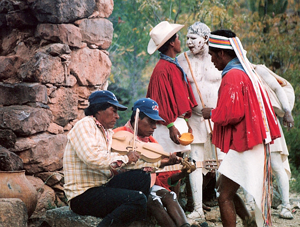
The Tarahumara is a tribe of indigenous people of the northern regions of Mexico. Although they were originally from what is now the state of Chihuahua, the Tarahumara, also called the Raramuri, now inhabit the Copper Canyon in the Sierra Madre mountain range where they have lived since the coming of the Spaniards in the 16th century. The Tarahumara tribe is best known to the western world for their athletic ability in long-distance running. The population of 50,000 to 70,000 Tarahumara that exist today remain largely a traditional people, living exactly as their ancestors did hundreds of years ago. Although separate villages are some distance apart, they maintain contact with the only means of transportation they have ever used – running. From an early age, the Tarahumara train their children in the art of long-distance running for both practical reasons and to keep tribal tradition alive. To celebrate their running skills, they play a game as they travel called “foot throwing” where they kick a ball back and forth amongst each other in a sort of relay. Individual games can last anywhere from a few hours to several days.

How to Run Like the Tarahumara
These indigenous people refer to themselves as the “Rarámuri,” or “those who run fast.” Entrenched in their culture is a tradition of running – sometimes literally hundreds of miles – with apparent ease, either barefoot or in rudimentary homemade sandals. For the Tarahumara, running is a way of life, vital to hunting, trade and communication in the remote Copper Canyon mountain region in which they live. Born to Run helped catapult the remote tribe of about 40,000 to mainstream notoriety, just over ten years ago, with its stories of the Tarahumara showing up to iconic American races such as the Leadville 100, shunning the free running shoes they were offered in favour of flat sandals, and beating professional athletes. Many continue to marvel at the Tarahumara’s apparent God-given gift to run for days, seemingly immune to fatigue or injury. In November 2019, British ultramarathon organisers staged a 250km running race through the Copper Canyon, inviting both Tarahumara and professional ultra runners to take on the challenge. The winner? Tarahumara local Miguel Lara of course, by a considerable margin.

Journey of Death in Tarahumara Country
In Northwest Mexico, the Rarámuri or Tarahumara ethnic group tenaciously exists in the middle of the vastness of the so-called Sierra Tarahumara. In Northwest Mexico, the Rarámuri (as they call themselves) or Tarahumar (as non-indigenous people call them) ethnic group exists tenaciously in the middle of the vastness of the so-called Sierra Tarahumara, which in truth corresponds to the portion of the Mexican State of Chihuahua of the environmental and cultural geographic conglomerate, which covers a certain portion of Northwest Mexico and the Southwest of the United States of America. This portion of the territory was originally more extensive than it is at present; it included an approximate surface of 75 400 km2, with wooded areas of the summit (of between two to three thousand meters of altitude), small plains and valleys, endless hillsides and deep ravines (of between 300 and 400 m) in which the main rivers flow that irrigate the northwestern coast and the extensive arid lands located to the east of the mentioned border state.

“The Rarámuri (Tarahumara) rely on the rich heritage of the many maize varieties that their ancestors domesticated and brought to the Sierra Tarahumara in NW Mexico. Women play an increasingly dominant role in maize production here, as more and more men migrate out for labor jobs. In the village of Norogachi, the rancherias of sandy soils and stone-walled fields are shaped to a complex landscape of hills, forests and streams. Just like their agriculture, the Rarámuri people and mythology integrate artfully into this landscape.”

The Tarahumara, or self-called Rarámuri, are one of the largest indigenous tribes in North America with nearly 100,000 people. The majority are concentrated in the highlands of the Sierra Madre Occidental, Mexico, while others choose to live in las barrancas – the gorges of the Sierra Madre. Despite their large number, the tribe managed to remain relatively uninfluenced by the surrounding Mexican culture until recently. This is primarily a result of the harsh landscape in which they live, and their general reluctance to embrace outsiders. The Tarahumara have maintained traditional cultural practices in light of ever-increasing outside pressures; in many cases they still rely on the customs of their ancestors. Conquistadors came in contact with the Tarahumara during the 16th century and brought with them Christian missionaries, domesticated animals, cultivated fruit trees, steel tools and certain musical instruments. The Tarahumara incorporated these concepts and items into their everyday life by varying degrees; however, their popular name “Tarahumara” is the most obvious Spanish influence – a mistranslation of the group’s own name, Rarámuri.

Myths of Mexico’s “Superrunners”
The Rarámuri people’s ancient traditions of footracing have captured global attention. New research by a biological anthropologist and his colleagues debunks stereotypes and contextualizes the community’s famous races. ON A MESA above 6,000 feet in elevation among the Sierra Madre peaks of Northwestern Mexico, the Rarámuri racers, carrying flaming torches under a star-studded sky, ran steadily. The teams had been at this rarajípare event since noon and would persist past midnight. The runners maintained a roughly 10-minute-mile pace, racing back and forth on a more than 3-mile track. Around them, people shouted encouragement in the Rarámuri language: “Iwériga!” (Breath! Soul!) and “Iwérisa!” (Stamina!).
RARÁMURI [TARAHUMARA] PEOPLE

Why the Tarahumara Run Ultra-Long Distances
The Tarhumara of Northern Mexico, or “Rarámuri,” which means “light feet” or “runners on foot,” are known worldwide for their ability to run ultra long distances. Christopher McDougall’s bestselling book “Born to Run,” popularized the concept of the Tarahumara runners as superathletes. Harvard anthropologist and evolutionary biologist, Daniel Lieberman, views the Tarahumara’s running achievement with a different perspective. As the lead author of “Running in Tarahumara (Rarámuri) Culture,” he and his co-writers point out that there are many more social and contexual layers to the Tarahumara’s running culture.

Running in Tarahumara (Rarámuri) Culture
The Tarahumara (Rarámuri) are a Native American people from Chihuahua, Mexico, who have long been famous for running, but there is widespread incredulity about how and why they run such long distances. Some characterizations of Tarahumara running are also based on stereotypical views of athleticism among non-Western peoples, here labeled the “fallacy of the athletic savage.” To place Tarahumara running more appropriately into its larger social and functional contexts, we combined our own observations and ethnographic evidence with interviews of 10 elderly Tarahumara runners about running during hunting as well as during footraces. We detail how running played an integral role in persistence hunting, in which groups of hunters employed a variety of methods to chase animals on foot. Running during hunting, moreover, is linked to men’s and women’s footraces, and both kinds of running are considered powerful forms of prayer. Long-distance running is also related to endurance dances that have important spiritual dimensions. Although the Tarahumara do not train to run in any traditional Western sense, and not all of them are great runners, the Tarahumara, like many Native American peoples, consider running, along with other endurance-based activities, to be important social and spiritual pursuits.

For over a century, the Tarahumara have been famous for their long distance running traditions and abilities, with many accounts claiming they have superhuman athletic abilities that partly result from being uncontaminated by westernization. Now an international team of researchers (including a champion Tarahumara runner) combine their own observations with detailed interviews of elderly Tarahumara runners to dispel these stereotypical myths, which they term the “fallacy of the athletic savage.” Lieberman and colleagues use accounts by Tarahumara runners to detail the various ways Tarahumara used to run for hours to hunt animals, and they describe how the Tarahumara still run traditional long distance races that, for men, involve chasing a small wooden ball and, for women, a hoop. While these many different kinds of running have important social dimensions, running is also a spiritually vital form of prayer for the Tarahumara.

Tarahumara Religion and Ritual
How many years have the Tarahumara people have lived in what is now the Mexican state of Chihuahua? No one knows for sure. When the Spanish arrived in the late 1500s to the southern part of their homeland, the Tarahumara lived in small farming villages in the mountains and the lowlands. Some researchers believe these people migrated south as refugees from the collapsing Mogollon Culture which flourished from about 200 AD to around 1400 AD in what is now the northern part of the Mexican state of Chihuahua and the southern parts of the US states of Arizona and New Mexico. When the Spanish encountered the Tarahumara, these people told the Europeans that they called themselves the Rarámuri. Today the word Rarámuri is used by indigenous purists and by a newly sensitive Mexican government to describe the Tarahumara, although in the Tarahumara language the name rarámuri literally means “men.” In their language the word “woman” is mukí and “women” are called omugí or igómale. So those wishing to be more inclusive and “decolonizing” and use the term Rarámuri are only describing half the population of these people. As is standard throughout Mexico Unexplained, the commonly known term to English-speakers is used, and in this case that would be a simple “Tarahumara.”

Many of you may have read about these indigenous Indians of Copper Canyon in the book Born to Run. Although the book exaggerates their lifestyle a bit and sensationalizes their uniqueness, the truth remains. This is a culture that has maintained and held on to their values and philosophy of life, despite the years of industrialization and influx of people mining in Copper Canyon and tourists visiting in increasing numbers. Unlike many other indigenous Indian tribes throughout Latin America who have been assimilated into the dominant western culture, the Tarahumara, whose real name is Raramuri, the “running people,” have maintained their own identity. Trying not to idealize them, it has been said by researchers and anthropologists and highlighted in “Born to Run”. “Left in their mysterious canyons, hidden, this tribe strives to live in peace and has solved nearly every problem known to man…. Mind, body, or soul…working toward the end of hatred, corruption, greed and the health problems that plague modern man including obesity, drug addiction, diabetes, high blood pressure and depression.”

Mulaka – “The Mythological Creatures”


Comments
Post a Comment