Mythologies of the Purépecha Tribe

The Purépecha (endonym Western Highland Purepecha: P’urhepecha [pʰuˈɽepet͡ʃa]) are a group of indigenous people centered in the northwestern region of Michoacán, Mexico, mainly in the area of the cities of Cherán and Pátzcuaro. They are also known by the pejorative “Tarascan“, an exonym, applied by outsiders and not one they use for themselves. The Purépecha occupied most of Michoacán but also some of the lower valleys of both Guanajuato and Jalisco. Celaya, Acambaro, Cerano, and Yurirapundaro. Now, the Purépecha live mostly in the highlands of central Michoacán, around Lakes Patzcuaro and Cuitzeo.

CURICAUERI
“The Great Fire”, main deity with a black painted body, although the lower part of the face as well as feet nails and hands were painted yellow; wore a white skin head piece and a heron feather ornament on his back. Accordingly, the cazonci, priests and chiefs were painted black. Three descriptions of this deity exist in the “Relacion de Michoacan. Depicted as a white eagle with a large wart in the forehead; also a personage covered with charcoal dust (Entiznado)” with white heron plumages on his head and back; and most frequent it is described as “… that stone said to be God Curicaueri.” According to Mythological Stories the God Curicaueri was identified with the sun.
CUPANTZIERE
The old sun “Cupantziere” plays ball with “Ahchurihirepe” that represents the night. The old sun is defeated, but his son, the young sun “Siratatáperi” arises by the east and rescues his father’s corpse, who resurrects in the form of a deer that goes away to the north. The deer were considered sacred animals associated to the sun in diverse Mesoamerican cultures, as divine food. Among the tarascos its skin was tanned and used to cover the Curicaueri image.
CUERAUAPERI
“The one that unties in the womb”, associated with birth and considered the mother of all Gods, men, animals and plants. Its main sanctuary was in Tzinapécuaro.
CURITACAHERI
The great priest and Sun’s Messenger, related with the Sea God who received offerings from shells.

URENDEQUAUECARA or HURENDEQUAUECARA
Morning star related to Venus and the eastern region. Related to Pungarancha War God.
TIRIPEMES or TIRIPEMENCHA
Gods of the “four parts of the world” considered Curicaueri siblings: Tiripeme-xungápeti, “the yellow God” north deity, lord of Pichátaro; Tiripeme-turupten, “the white God” best deity, lord of Iramuco; Tiripeme-caheri, “the black God” south deity, lord of Pareo and; Tiripeme-quarencha, “the red God” east deity, lord of Curínguaro.
ANGAMU CURACHA
Were the forest gods.
GOD OF HELL
The Cuingo celebration sacrifices (skin removal) were dedicated to the God of hell.
XARATANGA
“The one that appear in the top” or “the one that illuminates or shines”, goddess of the moon and maintenance, she made plants germinate and took care of men and animals. As other goddesses associated with the moon in Mesoamerican cultures, one of its characteristics was its relation with love, sex and Octli (pulque).

Near Lake Patzcuaro in Michoacán, indigenous women embroider colorful pictures that can be framed or made into decorative pillows and clothing. The themes of these embroidered “stories” originally came from ancient mythology of the Tarascan or Purepecha Indians, drawn from seals found in Tzintzuntzan. Gradually many women there began depicting traditional village dances such as the Dance of the Viejitos and festivals such as Dia de los Muertos. The artisans also embroider scenes of women cooking, men fishing, and other scenes of daily life in a Purepecha village.

Purepecha, Tarascan or Michoacan is a language spoken by members of the Purepecha people of western Mexico, mainly in the state of Michoacan. It has many linguistic features that make it seem like a unique language, very different from other Mesoamerican languages. It has 142,459 speakers. In fact, the Purepecha language has been classified as a isolated language, since up to now it has not been possible to establish any relationship of common origin with any of the languages that were spoken, or are spoken, in Mexico or another country, although Morris Swadesh suggested some remote lexical similarity with other languages of the Americas. This proposal has not been widely accepted by specialists in these other languages. Purepecha is one of the indigenous languages of Mexico with the greatest vitality. It’s recognized as a national language and it’s regulated by the Academy of Purepecha language.

Pyramids of Tzintzuntzan: Vestiges of the Purépecha Empire
On the banks of Lake Pátzcuaro in Mexico, the stone ruins of Tzintzuntzan pay homage to the great capital of the pre-Colombian Purépecha civilization which existed from the 14th to the 16th century. What secrets are contained within the partially excavated rubble?
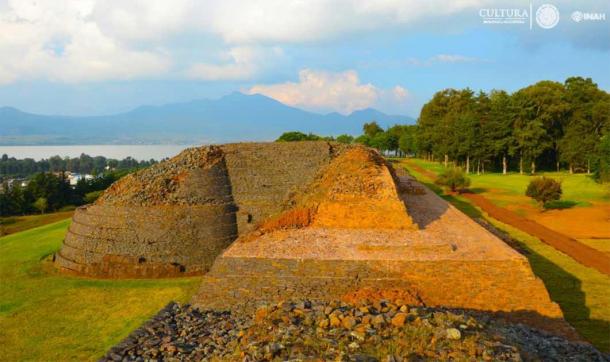
Detail of the Tzintzuntzan pyramid structures with Lake Pátzcuaro in the background.
Tzintzuntzan Ruins: Stones Revealing Their Secrets
Once the heart of the Purépecha Empire, the Lake Pátzcuaro basin is home to the ancient remains at Tzintzuntzan, which became the center of power for the Purépecha in the 15th century. The name itself comes from the Purépecha Ts’intsuntsani, which translates to mean “place of hummingbirds”. When the Spanish arrived in the 1520s the town is said to have had a population of about 30,000 people.

All but forgotten, excavations began in the 1930s and, so far, only about 35% of the site has been excavated. Over the decades, archaeologists have attempted to understand and conserve the history and magnificence of the enormous platform built into Tahuarato hill measuring 450 by 250 meters (1476 ft by 820 ft), on which five yácatas, or rounded pyramids, can still be seen today.
Earrings of the Moon

An old Purépecha legend tells of how for many thousands of years the Sun and the Moon were married and were very happy living in the heavens. Their peaceful lives changed when Citalimina arrived in the sky, known to modern-day peoples as the planet Venus, the star of the morning and evening skies. When the young and very feminine Venus first came on the scene, everything changed. One day, the Moon found the Sun talking to Venus. The Moon became jealous of her because Venus was a very beautiful star with a very long hair. The Moon accused the Sun of flirting with Venus and so the formerly peaceful and happy celestial duo began fighting and insulting one another. They fought physically, too, and as the Sun was stronger than poor Luna, it left her face full of bruises, which are the craters we can see on its surface from Earth if we observe it carefully.
Princess Eréndira
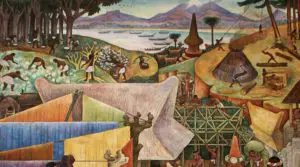
Tragedy of Hupanda
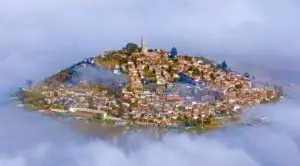
Hapunda, a word in the Purépecha language which now means “lake” or “lagoon,” in English, was once the name of a beautiful princess who lived on the island of Yunuén, one of the eight islands that are located in Lake Pátzcuaro, in the modern-day Mexican state of Michoacán. Seven such islands are currently populated. The island of Yunuén and Pacanda, form a group; another group is comprised of the islands of Tecuena and Tecuanita. The Urandes Islands makes up the third group. “Urandenes” is a name that comes from the Tarascan word urani, which means “batea” or “dough mixing bowl.” The last group is formed by the Jarácuaro and Copujo Islands. Apart from these islands, the famous Janitzio Island is located in the lake. The beautiful island of Yunuén has its meaning derived from the Tarascan term for “Half Moon”, because the island has a curved form like a moon.
Lady of the Waterfall

A legend from Tepuxtepec, Michoacán tells that at the waterfall of El Salto, in the modern-day municipality of Contepec, a group of Tarascan youths went swimming on a hot summer day. Even though they knew the danger they were in, they decided to defy fate and go swimming near a waterfall and a fast stream. The boys were enjoying the cool waters, already very late, under a beautiful full moon, when suddenly they saw a woman dressed in a white robe. The lady was very beautiful, her long hair of a black crow’s wing reaching beyond her waist. Her skin was extraordinarily white, almost as much as her dress. The woman walked, or rather levitated, along the riverbank where the waterfall was. She was crying piteously and heartbreakingly. When they saw her, the boys realized that she was getting closer to them. They were excited, because they thought that the woman was going to swim and so they could see how beautiful she looked up close. However, as they approached her, they all felt a terrible chill and the sensation that their hair stood on end.
Origin of Cerro del Tecolote
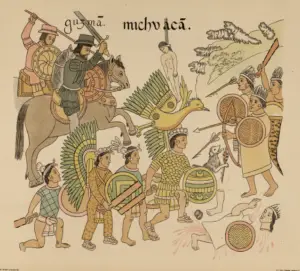
In the 12th century, the Purépecha people guided by Iré-Ticatame arrived in the Zacapu region. The leader liked the area very much and decided to settle in such a beautiful place. He built a temple to worship Curicaveri, the patron god of the group. Shortly after, he offered his friendship and support to the local chieftain of Naránxhan, called Zirán-Zirán, as long as they carried firewood, regularly, to the Curicaveri temple to make the sacred fire in his honor. Zirán agreed and offered Iré-Ticatame his daughter, Pisperama, also known as “The Marvelous Flower” to be his wife. From the union was born Sicuir-Achá, whose name in English means, “The Lord in Fur Dress.” After a while, Iré-Ticatame found his son making an arrow to kill off some of the Naránxhan people, because they had stolen the sacred deer that the young man had hunted as a tribute to the gods. Suddenly, a group of Naránxhans attacked the father and son and they fled quickly. Soon after, the transgressors surprised Iré-Ticátame to kill him. The Purépecha leader defended himself against many of the enemies using the sacred arrows that the gods had given him, but they were not enough. He had many vengeful enemies and the brave warrior fell dead.
The Tarascans, also known as the Purépecha, remain a mystery to this day. The modern-day Tarascans still live in their ancestral homeland, territories comprising most of the Mexican state of Michoacán and smaller areas of surrounding states. Anthropologists puzzle over the origins of this seemingly unique people, as the Tarascans are unlike any other group in Mesoamerica. Their language is a linguistic isolate in Mexico and unrelated to any local languages. Some linguists have linked the Purépecha language to the Zuni language of Arizona and New Mexico, thousands of miles to the north, while others see similarities to Quechua, the language of the Inca of South America. The Tarascan building style suggests a link with the Inca, but those who propose a South American connection do not know whether the Tarascans were once refugees or part of some ancient empire expansion that stretched north along the coast of the Americas.


Comments
Post a Comment