Mythologies of the Creek/Muskogee Tribe

The Creek mythology is related to an American Indian Creek people who are originally from the southeastern United States, also known by their original name Muscogee (or Muskogee), the name they use to identify themselves today.Mvskoke is their name in traditional spelling. Modern Muscogees live primarily in Oklahoma, Alabama, Georgia, and Florida. Their language, Mvskoke, is a member of the Creek branch of the Muskogean language family. The Seminole are close kin to the Muscogee and speak a Creek language as well. The Creeks were considered one of the Five Civilized Tribes. After the Creek War many of the Creeks escaped to Florida to create the Seminole.The early historic Creeks were probably descendants of the mound builders of the Mississippian culture along the Tennessee River in modern Tennessee and Alabama, and possibly related to the Utinahica of southern Georgia. More of a loose confederacy than a single tribe, the Muscogee lived in autonomous villages in river valleys throughout what are today the states of Tennessee, Georgia, and Alabama and consisted of many ethnic groups speaking several distinct languages, such as the Hitchiti, Alabama, and Coushatta. Those who lived along the Ocmulgee River were called “Creek Indians” by British traders from South Carolina; eventually the name was applied to all of the various natives of Creek towns becoming increasingly divided between the Lower Towns of the Georgia frontier on the Chattahoochee River, Ocmulgee River, and Flint River and the Upper Towns of the Alabama River Valley.

TOP NINE DEITIES IN MUSCOGEE CREEK MYTHOLOGY
NEREHVURESSE
The Muscogee Creek moon goddess. She was the wife of the sun god and, as with the moon goddess of the Choctaw people, it was said that she spent moonless nights having sexual relations with her husband. The differing phases of the moon were explained as Nerehvuresse covering her face in varying degrees of embarrassment over having all the world know when she had been sleeping with her spouse.
HVUSE

The sun god of the Muscogee. He was the father of the corn goddess and coupled with her to sire the hunting god. Fire was considered to be the manifestation of Hvuse on Earth and during Creek New Year festivals the entire community would renew their household fires from the main fire at the center of the village. Hvuse was associated with purity and when the very first Muscogee Creek people emerged from the subterranean world they eventually migrated eastward, toward the site of the sunrise, eventually settling in their ancient territory in what is now Alabama and Georgia. Eclipses were believed to be caused by a giant frog trying to swallow the sun god as he flew across the daytime sky. Loud noises were made during eclipses to help drive the monster away.
YAHOLA and HAYUYA

These two gods resided in the air and the clouds. They were the guardians of Muscogee people being given training in mysticism and the medical arts. Yahola and Hayuya were the two most prominent of the four Hiyouyulgee, divinities who tutored the ancient Muscogee about the use of fire and various plants, medicinal and otherwise. Yahola and his brother Hayuya endowed people with strength, creative inspiration and magical abilities. Both deities presided over the Busk Ground Ceremonies, the most important rituals in the Muscogee holiday calendar. Yahola in particular had special sovereignty over curing illnesses and the delivery of children. He was also the patron deity of the intoxicating Black Drink consumed in mass quantities by the Muscogee Creek, who would cry out his name when feeling the effects of the drink he had given to them as a gift. Yahola, Hayuya and the other two Hiyouyulgee visited the ancient Muscogee Creek during their mass migration eastward, appearing to them on a “mountain of thunder” near the Red River. The Creek were attracted by the sound of singing from the highest peak of this mountain. Climbing to that peak they sacrificed a child and the four Hiyouyulgee then appeared to them. The tribe lived near the mountain for four years before resuming their journey to the east.
KIKOMIHCI

The god who created human beings and animal life after the supreme deity Ibofanaga was finished creating the Earth, the heavens and the underground world. Kikomihci animated people and other animals with their “ghosts” which could leave their bodies at night in dreams and wander around, returning to their host body by morning to avoid causing illness. Ibofanaga was solely responsible for the actual “souls” of the beings Kikomihci created. Like the Inuit and other peoples the Muscogee Creek distinguished between an animating force and an actual “eternal” soul.
UVCE

The corn goddess of the Muscogee Creek people. Uvce created corn, beans and wormseed by scratching flesh from her body. She was the daughter of the sun god, and when she was an adult he went on to impregnate her with a child of her own. Uvce gave birth to a large clot of blood which she kept in a pot and which coalesced into a boy within a few days. This son, the hunting god Fayetu, was incredibly successful at shooting game with his bow and arrows and provided their table with plenty of meat in addition to the corn and beans that Uvce produced. The corn goddess and her child lived in the realm of the gods on the other side of the mountains which formed the Spine of the World. As Fayetu grew into a man she had always warned him to never climb to the peaks to look down on the land of mortals on the other side. After reaching manhood Fayetu disobeyed this command and, catching sight of how beautiful mortal women were, the hunting god told Uvce the time had come for him to leave her and seek a wife among humans. Saddened, Uvce made her son a headdress made of blue jay feathers and a flute that could summon any and all animals, even snakes. She told Fayetu to marry the first woman who cooked food for him and to make the world safe for his wife and her people by hunting down and eliminating monsters who preyed upon them. After he had done so he was to return to his mother’s home in the land of the gods to receive a final gift from her. Years later, as instructed, the hunting god returned to that home only to find nothing but enormous fields full of corn and beans. He collected as much as he could and took these gifts back to humans as an eternal gift from his mother.
FAYETU

The Muscogee Creek hunting deity. He was the child of the sun god Hvuse and the corn goddess Uvce but was raised by his mother alone. From a very young age he was successful at hunting all manner of game animals and after reaching manhood he left his mother to seek a wife in the land of mortals. As his mother instructed he married the first woman who agreed to cook food for him as he wandered among the ancient people. His wife was, of course, a member of the ancient Creek people. Her sister was married to the trickster deity Pasakola and this brother-in- law of Fayetu was often the source of trouble in myths. Fayetu’s sons were Chachusee, semi- divine chief of the ancient Muscogees, and Wikatca, the water god and lord of the snakes.
WIKATCA

The water god and lord of the snakes. He had the head of a cougar, the antlers of a deer, the wings of a bird and the body of a giant snake. Originally humanoid in form, Wikatca, then named Chatlahau, was hunting once with his brother Chachusee. Chatlahau was always dabbling in the forbidden and ate a taboo dish made from the brains of a black snake, a black squirrel and a wild turkey. Overnight he transformed into his hybrid form as the god Wikatca. Wikatca’s scales shone like precious metal and his antlers were formed of bright crystal. Only skilled shamans could approach Wikatca, shaking rattles and singing four sacred songs, thus soothing him enough to let them scrape some of his horns into a powder that could be used in making various charms and weapons. The god lived in a deep lake and ruled over all the world’s snakes, from the ordinary to the Tie-snakes, gigantic serpents who were formerly human beings who had fed on taboo foods and transformed like Wikatca himself. Once Wikatca coupled with a Creek woman who gave birth to his child. The woman and child were shunned by most of the inhabitants of their village, Coosa. The angry Wikatca had the mother of his child warn those few people of Coosa who had protected her and her offspring to evacuate. When they had done so Wikatca slithered out of his lake home, drawing floodwaters after him in a serpentine path and forever submerging Coosa, drowning all the remaining inhabitants. Whenever birds would fly over the waters where the village used to be a whirlpool would form and suck them down into it.

IBOFANAGA
The supreme deity of Muscogee Creek myths. He created the heavenly Upper World which was his home. This realm embodied perfection, order, permanence and clarity. Next he created the Lower World which was home to various dark forces and which embodied imperfection, madness, chaos as well as, oddly enough, fertility and creativity. (?) If the Upper World and Lower World came into contact all of creation would be destroyed so Ibofanaga created the Earth as a Middle World or buffer zone between the two. Originally the Middle World consisted entirely of water and air, populated only by creatures who could inhabit those two elements. Eventually Ibofanaga had crawfish serve as earth-divers, retrieving enough soil from the bottom of the ocean for him to form land masses with. Kikomihci created humans and other land animals, animating them via “ghosts” which were entirely separate from “souls”, which were the creation and province of Ibofanaga.

By-The-Door and Thrown-Away
(also known as Lodge Boy and Bad Boy.)
These mythical twins, born when their pregnant mother was killed by a monster, are common to the folklore of many Midwestern and Eastern tribes. In Creek mythology, they are generally portrayed as rowdy monster-slayers who cause a lot of trouble during the course of their adventures.
Rabbit, the trickster figure in the folklore of the Creek and other Muskogean tribes.
A kind of hairy, man-eating ogre. Some recent Creek story-tellers have translated it as “gorilla.”
These are mythological water spirits common to the folklore of Southeastern tribes. They are the size and shape of an ordinary snake, but have immense strength. In Creek stories, Tie-Snakes lived underwater and were feared for their ability to catch humans and drag them underwater to drown.
A giant cannibal monster common to southeastern Indian legends. Although some storytellers describe it as resembling a giant bear or elephant, most Creek people associate it with a big cat, and its name is translated as “Lion” or “Great Lion” in many stories.

Creek Indian Legends
Creek Flood Myth:
Creek legend about the flooding of the earth and Dog’s noble self-sacrifice.
Florida Creek Folktales:
Muskogee Creek folklore and sacred stories from Florida.
Creek Myths and Tales:
Online collection of Muscogee legends.
The Cussitaws Come East:
Migration legend of the Cussitaw Creeks.
How Rabbit Brought Fire to the People:
Creek legend about the origin of fire.
How Day and Night Were Divided
The Story of Day and Night:
Muskogee myth about the creation of days.
How Rabbit Fooled Alligator:
Muskogee legends about Rabbit playing tricks on other animals.
Legend of the White Potato Clan:
Muskogee legend about the Creator’s gift to clanless children.
The Story of Walnut-Cracker:
A Hitchiti/Creek ghost story.
Why Bats Are Classified As Animals
Story of the Bat:
Creek story about a ball game between the birds and land animals.

Recommended Books on Creek Mythology
The Great Ball Game:
Picture book illustrating a Creek legend about a contest between the animals and the birds.
Southeastern Native American Legends:
Book comparing traditional Muskogee stories with the stories of other Southeast tribes.
American Indian Trickster Tales
Compilation of more than a hundred stories about Rabbit and other Native American tricksters.
(Use discretion sharing these with kids as some of the stories contain adult humor.)

The Muskogee are close neighbors of the Cherokee in Georgia and South Carolina, and there seems to be at least a little bit of overlap in their beliefs about the little people. Like the Cherokee, for example, they populated the ancient mounds with invisible “ghost warriors” who might be heard dancing or singing in the early morning. Unfortunately, the Muskogee rarely talk about these beings. These are “little people (said to cause people to get lost in the woods)”. When the Little People, who are great tricksters, are in the world then everything is right and safe as it should be. “The Little People tell Creeks that the plant world is alive and well, for these Little People move when disaster is on the way.”

http://www.indigenouspeople.net/creek.htm
MUSKOGEE CREEK LITERATURE
“Experience is the wisest teacher, and history does not furnish
an example of a forced civilization being permanent and real.”
Pleasant Porter, 1973
The Muscogee (or Muskogee), also known as the Creeks, are a Native American people traditionally from the southeastern woodlands. Mvskoke is their name in traditional spelling. Today Muscogee people live primarily in Oklahoma, Alabama, Georgia, and Florida. Their language, Mvskoke, is a member of the Muscogee branch of the Muscogean language family.
The Muscogee are descendants of the Mississippian culture peoples, who built earthwork mounds at their regional chiefdoms located throughout the Mississippi River valley and its tributaries. The historian Walter Williams and others believe the early Spanish explorers encountered ancestors of the Muscogee when they visited Mississippian-culture chiefdoms in the Southeast in the mid-16th century.

The Muscogee were the first Native Americans considered to be “civilized” under George Washington’s civilization plan. In the 19th century, the Muscogee were known as one of the “Five Civilized Tribes”, because they had integrated numerous cultural and technological practices of their more recent European American neighbors. Influenced by their prophetic interpretations of the 1811 comet and earthquake, the Upper Towns of the Muscogee, supported by the Shawnee leader Tecumseh, began to resist European-American encroachment. Internal divisions with the Lower Towns led to the Red Stick War (Creek War, 1813–1814), begun as a civil war within the Muscogee Nation, it enmeshed them in the War of 1812 against the United States.
During the Indian Removal of the 1830s, most of the Muscogee Confederacy were forcibly relocated to Indian Territory. The Muscogee (Creek) Nation, Alabama-Quassarte Tribal Town, Kialegee Tribal Town, and Thlopthlocco Tribal Town, all based in Oklahoma, are federally recognized, as are the Poarch Band of Creek Indians of Alabama, the Coushatta Tribe of Louisiana, and the Alabama-Coushatta Tribe of Texas.
CREEK LEADERS
Opothle Yoholo
“Ho-Po-Eth-Le-Yo-Ho-Lo.”
Paddy Carr

Tustennuggee Emathla
(Jim Boy)
Yoholo-Micco
Menawa
The Great Warrior
Chief of the Upper Muskokee (Creek)
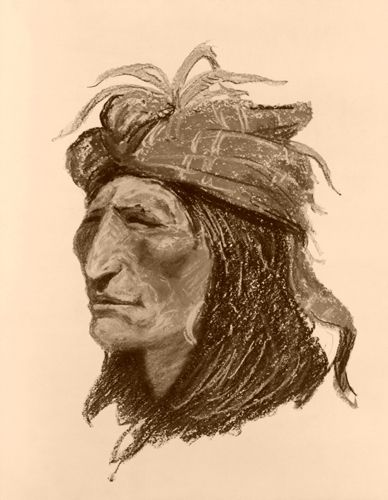
Menawa, also called Hothlepoya, was war chief of the Upper Towns Creek. Born in the 1780s, he had earned the title “Crazy War Hunter” for his exploits in battle, including his bravery at the battle of Horseshoe Bend in 1814. He fervently hated the white man and refused to join Chief William McIntosh’s conciliatory efforts. After watching his tribe cede its land piecemeal for a decade, culminating in a treaty which forced the Creek to relocate, Menawa led a raiding party which killed McIntosh in 1825. The act did not stop white incursion onto Creek land, however, and Menawa himself was forced to accede to white territorial demands the following year in a treaty concluded with Secretary of War James Barbour.

In the early 1700’s, the Creek tribe was the most cooperative with the British settlers in the Georgia Territory. With the active assistance of Creek leaders like Tomochichi (shown here with his nephew), Georgia was rapidly and peacefully settled by British colonists. In return for massive land grants, the Creek were accorded privileges, such as protection under the British law and liberal trading rights. Tomochichi was praised for his peacemaking efforts, and in 1734 was rewarded with a trip to England with his family. He remained a friend to the British for the rest of his life
The Muskokee (Creek) became a combined Muskokee (Creek) Confederacy of most nations of the southeastern states who thrived as early as de Soto’s time in the early 1500s. Two strong geographical groups, the Upper Muskokee (Creek) and Lower Muskokee (Creek), each possessed many interesting nations that gradually increased in size and spread throughout Georgia, Alabama, Florida, Louisiana, Mississippi, and the Carolinas. As white people spread southward along coastal areas, Muskokee (Creek) were driven to the interior areas, especially along the Chattahoochee and Ocmulgee rivers. In the 1700s and 1800s bands of the Muskokee (Creek) nation migrated northward, infiltrating nations of the central, plains, and southwestern areas.
Creek images
North Georgia Creek History

STORIES
How Day and Night Were Divided
After the world was made, some of the animals wanted the day to last all the time. Others preferred that it be night all the time. They quarrelled about this and could come to no agreement. After a while they decided to hold a meeting, and they asked Nokosi the Bear to preside.
Nokosi proposed that they vote to have night all the time, but Chew-thlock-chew the Ground Squirrel said: “I see that Wotko the Raccoon has rings on his tail divided equally, first a dark colour then a light colour. I think day and night ought to be divided like the rings on Wotko’s tail.”
The animals were surprised at the wisdom of Chew-thlock-chew. They voted for his plan and divided day and night like the dark and light rings on Wotko the Raccoon’s tail, succeeding each other in regular order.
But Nokosi the Bear was so angry at Chew-thlock-chew for rejecting his advice that he thrust out a paw and scratched the Squirrel’s back with his sharp claws. This is what caused the thirteen stripes on the backs of all his descendants, the Ground Squirrels.

How Rabbit Brought Fire to the People
In the beginning there was no fire and the earth was cold. Then the Thunderbirds sent their lightning to a sycamore tree on an island where the Weasels lived. The Weasels were the only ones who had fire and they would not give any of it away.
The people knew that there was fire on the island because they could see smoke coming from the sycamore, but the water was too deep for anyone to cross. When winter came the people suffered so much from the cold that they called a council to find some way of obtaining fire from the Weasels. They invited all the animals who could swim.
“How shall we obtain fire?” the people asked.
Most of the animals were afraid of the Weasels because they were bloodthirsty and ate mice and moles and fish and birds. Rabbit was the only one who was brave enough to try to steal fire from them. “I can run and swim faster than the Weasels,” he said. “I am also a good dancer. Every night the Weasels build a big fire and dance around it. Tonight I will swim across and join in the dancing. I will run away with some fire.”
He considered the matter for a while and then decided how he would do it. Before the sun set he rubbed his head with pine tar so as to make his hair stand up. Then, as darkness was falling, he swam across to the island.
The Weasels received Rabbit gladly because they had heard of his fame as a dancer. Soon they had a big fire blazing and all began dancing around it. As the Weasels danced, they approached nearer and nearer the fire in the centre of the circle. They would bow to the fire and then dance backwards away from it.
When Rabbit entered the dancing circle, the Weasels shouted to him: “Lead us, Rabbit!” He danced ahead of them, coming closer and closer to the fire. He bowed to the fire, bringing his head lower and lower as if he were going to take hold of it. While the Weasels were dancing faster and faster, trying to keep up with him, Rabbit suddenly bowed very low so that the pine tar in his hair caught fire in a flash of flame.
He ran off with his head ablaze, and the angry Weasels pursued him, crying, “Catch him! Catch him! He has stolen our sacred fire! Catch him, and throw him down!”
But Rabbit outran them and plunged into the water, leaving the Weasels on the shore. He swam across the water with the flames still blazing from his hair.
The Weasels now called on the Thunderbirds to make it rain so as to extinguish the fire stolen by Rabbit. For three days rain poured down upon the earth, and the Weasels were sure that no fire was left burning except in their sycamore tree.
Rabbit, however, had built a fire in a hollow tree, and when the rain stopped and the sun shone, he came out and gave fire to all the people. After that whenever it rained, they kept fires in their shelters, and that is how Rabbit brought fire to the people.

Long ago, the Creek nation lived mostly in the area of Georgia and Florida. Tribal storytellers loved to relate the following legend over and over to their young people, who loved to hear it again and again.
When the animals talked with each other just like people do today, a very handsome alligator lay sunning himself luxuriously on a log in which we now call the Florida Everglades. Then along came Mr. Rabbit, who said to him, “Mr. Handsome Alligator, have you ever seen the devil?”
“No, Mr. Rabbit, but I am not afraid of the devil. Are you?” replied Mr. Alligator.
“Well now, Mr. A., I did see the devil. Do you know what he said about you?” asked Rabbit.
“Now, just what did the devil have to say about me?” Alligator replied.
“The devil said that you are afraid of him,” said Rabbit. “Besides, he said you would not even look at him.”
“Rubbish,” said Alligator. “I know that I am not afraid of the devil and I am not afraid to look at him. Please tell him so for me the next time you see him.”
“I do not think you are willing to crawl up the hill the day after tomorrow and allow me to introduce you to the devil himself,” said Rabbit.
“Oh, yes, I am willing and ready to go with you,” replied Alligator. “Let us go tomorrow.”
“That is just fine with me,” replied Rabbit. “But Mr. A., when you see some smoke rising somewhere, do not be afraid. It is a sign that the devil is moving about and will soon be on his way.”
“You do not have to worry about me,” said Alligator. “I told you I am not afraid of the devil.”
“When you see the friendly birds flying about, and the deer running at a gallop, do not be afraid,” said Rabbit.
“Don’t you be concerned, because I will not be afraid,” repeated Alligator.
“If you hear some fire crackling and its comes closer to you, do not be scared,” said Rabbit. “If the grasses near you begin to smoke, do not be scared. The devil is only wandering about. Then is the time for you to get a good look at him when the heat is hottest.”
After Rabbit’s final words of wisdom, he left Alligator sunning himself.
Next day, Rabbit returned and asked Alligator to crawl up the hill, following him. Rabbit led him to the very top and directed him to lie in the tallest grass. Then Rabbit left Alligator, laughing to himself all the way down the hill, because he had led Alligator to the farthest place away from his home in the water.
On his way, Rabbit came to a smoldering stump. He picked up a piece, carrying it back to the high grass, where he made a fire so the wind blew it toward Alligator.
Soon the fire surrounded the place, burning closer and closer to Alligator. Rabbit then ran to a sandy knoll and sat down to watch the fun, chuckling over the trick he had played on Mr. Alligator.
Only a short time passed when the smoke rose in thick spirals, and the birds flew upward and away. Other animals ran for their lives across the field.
Alligator cried out, “Oh, Mr. Rabbit, where are you?”
“You just lie there quietly,” replied Rabbit. “It’s only the devil prowling about.”
The fire began to roar and spread rapidly. “Oh, Mr. Rabbit, what is that I hear?” asked Alligator.
“That’s just the devil breathing hard,” replied Rabbit. “Do not be scared. You will see him soon!”
Rabbit became so amused that he rolled and rolled on the sandy knoll and kicked his heels up in the air with glee.
Soon the grass surrounding Alligator caught fire and began to burn beneath him. Alligator rolled and twisted with pain from his burns.
“Do not be afraid now, Mr. Alligator,” called Rabbit. “Just be quiet for a little while longer, and the devil will be there for you to get a firsthand look at him.”
Alligator could not stand any more toasting! He started to crawl as fast as he could down the hillside toward the water. He wriggled through the burning grass, snapping his jaws, rolling in pain, and choking from the smoke.
Rabbit, upon his sandy knoll, laughed and laughed, jumping up and down with delight at the trick he had played on Alligator.
“Wait a minute, Mr. A. Don’t be in such a hurry. You said you were not afraid of the devil,” called Rabbit.
By that time Alligator had reached his home in the water, tumbling in to stop the pain of his roasted skin.
Never again did Mr. Handsome Alligator trust that trickster, Mr. Rabbit, or any of his family, ever!


Two pretty girls lived not far from Rabbit and Wolf. One day Rabbit called upon Wolf and said, “Let’s go and visit those pretty girls up the road.”
“All right,” Wolf said, and they started off.
When they got to the girls’ house, they were invited in, but both girls took a great liking to Wolf and paid all their attention to him while Rabbit had to sit by and look on. Rabbit of course was not pleased by this, and he soon said, “We had better be going back.”
“Let’s wait a while longer,” Wolf replied, and they remained until late in the day. Before they left, Rabbit found a chance to speak to one of the girls so that Wolf could not overhear and he said, “The one you’ve been having so much fun with is my old horse.”
“I think you are lying,” the girl replied.
“No, I am not. You shall see me ride him up here tomorrow.”
“If we see you ride him up here,” the girl said with a laugh, “we’ll believe he’s only your old horse.”
When the two left the house, the girls said, “Well, call again.”
Next morning Wolf was up early, knocking on Rabbit’s door. “It’s time to visit those girls again,” he announced.
Rabbit groaned. “Oh, I was sick all night,” he answered, “and I hardly feel able to go.”
Wolf kept urging him, and finally Rabbit said, “If you will let me ride you, I might go along to keep you company.”
Wolf agreed to carry him astride of his back. But then Rabbit said, “I would like to put a saddle on you so as to brace myself” When Wolf agreed to this, Rabbit added: “I believe it would be better if I should also bridle you.”
Although Wolf objected at first to being bridled, he gave in when Rabbit said he did not think he could hold on and manage to get as far as the girls’ house without a bridle. Finally Rabbit wanted to put on spurs.
“I am too ticklish,” Wolf protested.
“I will not spur you with them,” Rabbit promised. “I will hold them away from you, but it would be nicer to have them on.”
At last Wolf agreed to this, but he repeated: “I am very ticklish. You must not spur me.”
“When we get near the girls’ house,” Rabbit said, “we will take everything off you and walk the rest of the way.”
And so they started up the road, Rabbit proudly riding upon Wolf’s back. When they were nearly in sight of the house, Rabbit raked his spurs into Wolf’s sides and Wolf galloped full speed right by the house.

“Those girls have seen you now,” Rabbit said. “I will tie you here and go up to see them and try to explain everything. I’ll come back after a while and get you.”
And so Rabbit went back to the house and said to the girls: “You both saw me riding my old horse, did you not?”
“Yes,” they answered, and he sat down and had a good time with them.
After a while Rabbit thought he ought to untie Wolf, and he started back to the place where he was fastened. He knew that Wolf must be very angry with him by this time, and he thought up a way to untie him and get rid of him without any danger to himself. He found a thin hollow log and began beating upon it as if it were a drum. Then he ran up to Wolf as fast as he could go, crying out: “The soldiers are hunting for you! You heard their drum. The soldiers are after you.”
Wolf was very much frightened of soldiers. “Let me go, let me go!” he shouted.
Rabbit was purposely slow in untying him and had barely freed him when Wolf broke away and ran as fast as he could into the woods. Then Rabbit returned home, laughing to himself over how he had fooled Wolf, and feeling satisfied that he could have the girls to himself for a while.
Near the girls’ house was a large peach orchard, and one day they asked Rabbit to shake the peaches off the tree for them. They went to the orchard together and he climbed up into a tree to shake the peaches off. While he was there Wolf suddenly appeared and called out: “Rabbit, old fellow, I’m going to even the score with you. I’m not going to leave you alone until I do.”
Rabbit raised his head and pretended to be looking at some people off in the distance. Then he shouted from the treetop: “Here is that fellow, Wolf, you’ve been hunting for!” At this, Wolf took fright and ran away again.
Some time after this, Rabbit was resting against a tree-trunk that leaned toward the ground. When he saw Wolf coming along toward him, he stood up so that the bent tree-trunk pressed against his shoulder.
“I have you now,” said Wolf, but Rabbit quickly replied: “Some people told me that if I would hold this tree up with the great power I have they would bring me four hogs in payment. Now, I don’t like hog meat as well as you do, so if you take my place they’ll give the hogs to you.”
Wolf’s greed was excited by this, and he said he was willing to hold up the tree. He squeezed in beside Rabbit, who said, “You must hold it tight or it will fall down.” Rabbit then ran off, and Wolf stood with his back pressed hard against the bent tree- trunk until he finally decidedhe could stand it no longer. He jumped away quickly so the tree would not fall upon him. Then he saw that it was only a leaning tree rooted in the earth. “That Rabbit is the biggest liar,” he cried. “If I can catch him I’ll certainly fix him.”
After that, Wolf hunted for Rabbit every day until he found him lying in a nice grassy place. He was about to spring upon him when Rabbit said, “My friend, I’ve been waiting to see you again. I have something good for you to eat. Somebody killed a pony out there in the road. If you wish I’ll help you drag it out of the road to a place where you can make a feast off it.”
“All right,” Wolf said, and he followed Rabbit out to the road where a pony was lying asleep.
“I’m not strong enough to move the pony by myself,” said Rabbit, “so I’ll tie its tail to yours and help you by pushing.”
Rabbit tied their tails together carefully so as not to awaken the pony. Then he grabbed the pony by the ears as if he were going to lift it up. The pony woke up, jumped to its feet, and ran away, dragging Wolf behind. Wolf struggled frantically to free his tail, but all he could do was scratch on the ground with his claws.
“Pull with all your might,” Rabbit shouted after him.
“How can I pull with all my might,” Wolf cried, “when I’m not standing on the ground?”
By and by, however, Wolf got loose, and then Rabbit had to go into hiding for a long, long time.

The birds challenged the four-footed animals to play them in a ball game. Each group agreed that all creatures that had teeth should play on the side of the animals, and all those that had feathers should play on the side of the birds.
They chose a suitable day, cleared a playing field, erected poles, and obtained balls from the medicine men.
When the players gathered, all that had teeth went on one side and those that had feathers went on the other. When the Bat came, he joined the animals that had teeth.
“No,” the animals said to Bat. “You have wings. You must play with the birds.”
Bat went over to the side of the birds, but they said: “No, you have teeth. You must play with the animals.” They drove him away, saying: “You are so small, you could do us no good anyway.
And so Bat went back to the animals, begging them to let him play with them. At last they agreed: “You are too small to help us, but as you have teeth we will let you remain on our side.”
The game began, and the birds quickly took the lead because they could catch the ball in the air where the four-footed animals could not reach it. The Crane was the best player, and he caught the ball so often that it looked as if the birds were going to win the game. As none of the animals could fly, they were in despair.
The little bat now entered the game, flying into the air and catching the ball while the Crane was flapping slowly along. Again and again Bat caught the ball, and he won the game for the four-footed animals.
They agreed that even though Bat was very small and had Wings he should always be classed with the animals having teeth.

A long time ago in western Georgia, among the Southeastern Creek Hitchiti Indians, lived Walnut-Cracker. His name was given him because he spent most of his time gathering, cracking, and eating walnuts in the same spot.
He always placed walnuts on a large stone and cracked them open, using a smaller stone. For the rest of the day and evening he ate walnuts. This was how Walnut-Cracker lived for many years. When he died, his people buried him at the place where the walnuts grew.
Some time later, a Creek hunter passed that very place and found a large mound of walnuts. As he was hungry, he cracked some and ate the good meat. Later that same evening the hunter returned. He sat down and cracked many walnuts on the large stone.
While the hunter was busy cracking and eating walnuts, a man came out of his nearby lodge. He heard someone at the place where Walnut-Cracker had lived. He listened and plainly heard the cracking noise. Looking closely through the darkness, he saw what looked like a person sitting where Walnut-Cracker always sat.
The man went back into his lodge announcing, “Walnut-Cracker, who died and was buried, now sits at his same place, cracking walnuts on the large stone! Do you think it is his ghost?”
All of the man’s family came outside quietly, looking toward Walnut-Cracker’s place. There they saw someone cracking walnuts on the large stone, who surely looked like Walnut-Cracker himself.
One of the family was a Lame Man, a good friend of Walnut- Cracker.
“Take me along on your back,” he pleaded. “I want to see him again.” So he was carried on the back of another who walked quietly toward the ghost.
That is what they thought, and they stopped in fear. But Lame Man whispered, “Please, take me a little farther.” His companion took him a little way, then stopped. The hunter did not hear them, because he was cracking walnuts.
“Please take me a little farther,” again asked Lame Man. The hunter looked up and saw the people through the shadows. He jumped up, seized his bow and arrows, and ran away!
When the ghost moved, the people ran back to their lodge. The one carrying the Lame Man became frightened and dropped him and left, running back to the lodge. Lame Man, too, jumped up and ran to his people. He was no longer a lame man!
Tribal storytellers say, “He outran the others, beating them to the lodge. He walked perfectly ever after.”
As for Walnut-Cracker, no one saw his ghost again!
The Muscogee tribe, also called the Creek, was made up of several separate tribes that occupied Georgia and Alabama in the American Colonial Period. Their confederacy, which formed the largest division of the Muscogean family, included other Muscogean tribes such as the Catawba, Iroquois, and Shawnee, as well as the Cherokee. Together, they were sufficiently numerous and powerful to resist attacks from the northern tribes. They received their name from the English on account of the numerous streams in their territory.
It is believed that the Creek culture began as a way to guard against other larger conquering Indian tribes of the region. One of the Five Civilized Tribes, they formed the Creek Confederacy with other Muscogean speaking tribes, the Alabama, Hitchiti, and Coushatta. The Creek Confederacy was in constant flux, its numbers and land possessions ever-changing as small bands joined and withdrew from the alliance. Society was organized in matrilineal, exogamous clans, each bearing the name of its totem animal.
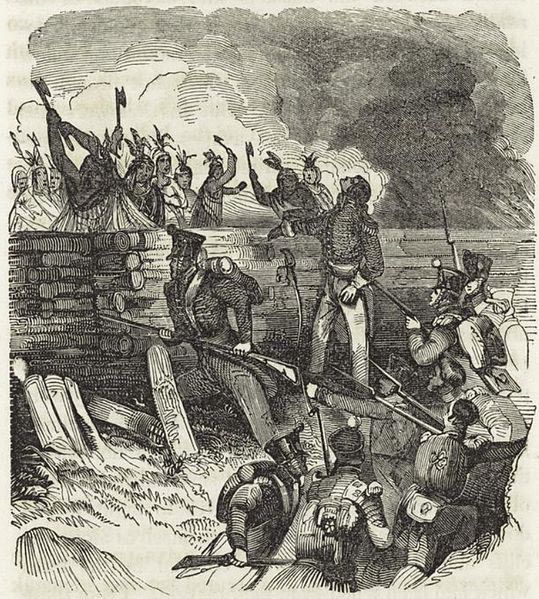
The economy centered upon agriculture, growing corn, beans, squash, pumpkins, melons, and sweet potatoes. When war erupted in 1813 between the United States and the Red Stick faction of the Creek Nation, a series of raids were launched against the white settlements. These raids culminated in the sacking of Fort Mims, in which 400 settlers were killed. General Andrew Jackson defeated the Red Sticks at Horseshoe Bend and exacted a disastrous cession of 23 million acres of land from the Creek tribe.

Battle of Horseshoe Bend, Alabama
When Jackson became president, he forcibly removed the Creek to what is now Oklahoma. Today, the Creek Confederation has its capital in Okmulgee, Oklahoma; but there are a few surviving bands in Alabama, Georgia, and Florida.
Nothing certain can be said of their previous condition, or of the time when the confederacy was established, but it appears from the narratives of the Spanish explorer, Hernando de Soto’s expedition that leagues among several of these towns existed in 1540, over which, head chiefs presided.
For more than a century before their removal to the west, between 1836 and 1840, the people of the Creek Confederacy occupied some 50 towns, in which were spoken six distinct languages — Muscogee, Hitchiti, Koasati, Yuchi, Natchez, and Shawnee. The first three were of Muscogean stock.
About half the confederacy spoke the Muscogean language, which thus constituted the ruling language and gave name to the confederacy. The meaning of the word is unknown. Although an attempt has been made to connect it with the Algonquian, the probabilities seem to favor a southern origin. The people speaking the cognate Hitchiti and Koasati were contemptuously designated as “Stincards” by the dominant Muscogee. The Koasati seem to have included the ancient Alibamu of central Alabama, while the Hitchiti, on lower Chattahoochee River, appear to have been the remnant of the ancient people of southeast Georgia, and claimed to be of more ancient occupancy than the Muscogee. Geographically the towns were grouped as Upper Creek, on the Coosa and Tallapoosa Rivers in Alabama, and Lower Creek, on the middle or lower Chattahoochee River, on the Alabama-Georgia border.
While the Seminole were still a small body confined to the extreme north of Florida, they were frequently spoken of as Lower Creeks. To the Cherokee, the Upper Creeks were known as Ani-Kusa use, from their ancient town of Kusa, or Coosa, while the Lower Creeks were called Ani-Kawita, from, their principal town Kawita, or Coweta. The earlier Seminole emigrants were chiefly from, the Lower Creek towns.
The history of the Creek begins with the appearance of De Soto’s array in their country in 1540. Spanish conquistador, Tristan de Luna came in contact with part of the group in 1559, but the only important fact that can be drawn from the record is the deplorable condition into which the people of the sections penetrated by the Spaniards had been brought by their visit. Another Spanish explorer, Juan del Pardo, passed through their country in 1567, but Juan de la Vandera, the chronicler of his expedition, has left little more than a list of unidentifiable names.
The Creek came prominently into history as allies of the English in the Apalachee Wars of 1703-08, and from that period continued almost uniformly as treaty allies of the South Carolina and Georgia colonies, while hostile to the Spaniards of Florida. The only serious revolt of the Creek against the Americans took place in 1813-14, in the well-known Creek war, in which General Andrew Jackson took a prominent part. This ended in the complete defeat of the Indians and the submission of Weatherford, their leader, followed by the cession of the greater part of their lands to the United States. The extended and bloody Seminole War in Florida, from 1835-1843, secured permanent peace with the southern tribes.

The removal of the larger part of the Creek and Seminole people and their black slaves to the lands assigned them in Indian Territory took place between 1836 and 1840.
The Creek woman was short in stature but well-formed, while the warrior, was generally larger than the Europeans, often above six feet in height, said to have been erect in his carriage, and graceful in every movement. They were described as proud, haughty, and arrogant; brave and valiant in war. As a people, they were more than usually devoted to decoration and ornament, were fond of music, and ball play was their most important game. Marriage outside the clan was the rule, adultery by the wife was punished by the relatives of the husband, and the descent was in the female line.
In government, it was a general rule that where one or more clans occupied a town they constituted a tribe under an elected chief, or miko, who was advised by the council of the town in all important matters, while the council appointed the “great warrior” or tustenuggi-hlako. They usually buried their dead in a square pit under the bed where the deceased lay in his house.
Certain towns were consecrated to peace ceremonies and were known as “white towns,” while others set apart for war ceremonials were designated as “red towns.” They had several orders of chiefly rank. Their great religious ceremony was the annual puskita, of which, the lighting of the new fire and the drinking of the black drink were important accompaniments.
The early statistics of the Creek population are based on mere estimates. In the last quarter of the 18th century, the Creek population may have been about 20,000, occupying from 40 to 60 towns. Estimates made after the removal to Indian Territory placed the population between 15,000 and 20,000.
After being forcibly removed to Indian Territory, most of the Lower Muscogee located farms on the Arkansas and Verdigris Rivers. The Upper Muscogee re-established their farms and towns on the Canadian River and its northern branches.
The Civil War was disastrous for the Muscogee people, even though the majority of the tribe desire neutrality. The first three battles of the war in Indian Territory occurred when Confederate forces attacked a large neutral band led by Opothle Yahola. Eventually, hundreds of Muscogee men fought on both the Union and Confederate sides. After the war ended, the reconstruction treaty of 1866 required the cession of approximately half of the Muscogee land — some 3.2 million acres.
In 1867, the Muscogee people adopted a written constitution, which provided for a Principal Chief and a Second Chief, a judicial branch, and two legislative chambers composed of a House of Kings (similar to the Senate) and a House of Warriors (similar to the House of Representatives.) Representation in both houses of this Legislative assembly was determined by each tribal town. A new capitol was established the same year at Okmulgee. In 1878 the tribal government constructed a native stone Council House. Today, it serves as the Council House Museum in the center of the modern city of Okmulgee.
This “constitutional” period lasted for the remainder of the 19th century. However, in the late 1800s, the Dawes Commission began negotiating with the Muscogee Nation for the allotment of land and in 1898, Congress passed the Curtis Act which required for the dismantling of the National governments of the Five Civilized Tribes.
In 1904 the “Creeks by blood” living in the Creek Nation, numbered 9,905, while Creek freedmen aggregated 5,473. The number of acres in their reserve in 1885 was 3,215,395.
In the early 20th century, the process of allotting lands to individual citizens was completed, but, dismantling of the Muscogee government was never fully executed, as the nation continued to maintain a Principal Chief
Long after the partial dismantling of the nation’s government, the tribe drafted and adopted a new constitution in the 1970s. They also revitalized the National Council and began challenging the earlier demands of the Federal Government in the Supreme Court, which affirmed the Nation’s sovereign rights to main



Comments
Post a Comment