MYTHOLOGIES OF BURMA

When people die, they do not always pass into the next world. According to Burmese folklore, some stay behind as Thayé and continue to haunt the world of the living. These ghosts resemble exceptionally tall, dark-skinned people with exaggeratedly large tongues and ears. They have tusk-like teeth and plague humans by inflicting minor illnesses and diseases. But keep in mind that I haven’t found a good source to confirm the claims about their appearance. They are related to (almost synonymous with) the ‘Preta’ ghosts of Buddhist tradition. In this incarnation, the ghosts are tall skinny ghosts of evil and selfish people. Pretas are cursed with unending hunger. Both Thayé and Pretas are generally seen as beings to be pitied, rather than evil or dangerous spirits. They suffer the consequences for the mistakes they made in life, and therefore cannot pass on to the afterlife.
![The Thayé [Burmese mythology]
When people die, they do not always pass into the next world. According to Burmese folklore, some stay behind as Thayé and continue to haunt the world of the living. These ghosts resemble exceptionally tall, dark-skinned...](https://64.media.tumblr.com/c3db6f17c8708181c0bd1d82010fc52c/905c50a6f6448728-5b/s640x960/88b98092426b9484e7f1843c154f342254df9479.jpg)
The sacred sites of Burma are amongst the most beautiful and spectacular in all of Asia. However, the fame and sacredness of these holy places rests almost solely on the myths and legends that surround their founding and the origins of their relics. The Buddha himself presented strands of his hair to two travelling merchants in Bodh Gaya, India. The pair returned to Burma where these ‘living hairs’ are venerated as the country’s most sacred relics, now enshrined in the Shwedagon Pagoda in Yangon. Folk Elements in Burmese Buddhism

It appears that this myth arose amongst the Mon but today it is known throughout the land. Similar myths and legends abound in Burma, always in connection with a sacred site, whether it be the cast bronze Mahamuni Buddha in Mandalay, the Buddha footprints found at Magwe or curious geological phenomena such as the Golden Rock at Kyaik-hti-yo.

The Saung is a unique musical instrument with a continuous history that stretches over a thousand years. It is known for its soothing, melodious sound and can be recognised by its horizontal boat-shaped body and its long, inwardly arched neck. The ends of the strings, which used to be made from silk, are decorated with red cotton tassels. The harp is held on the lap and the strings are plucked with one hand, while the other is used for damping and staccato notes. The Saung usually accompanies a singer, who also controls the tempo with a bell (Si) and a clapper (Wa). The earliest description of the Saung comes from a temple relief at Bawbawkyi in Sri Ksetra from the 8th century CE. It depicts a dancer with an accompanying harpist and a rhythm keeper. Tang chronicles from the 9th century also describe a delegation from the kingdom with thirty-five musicians and dancers that enchanted the court with their elaborate music performance. The orchestra included two harps and it performed twelve songs on Buddhist texts. These harps were tuned with pegs rather than strings, and interestingly peg-tuned harps are still used in Mon and Karen traditions. A later 10th-century Tang chronicle confirms that the music from these two geographic areas (from the present-day lower Myanmar) was the same.

The Buddhist traditions have created and maintained a vast body of mythological literature. The central myth of Buddhism is the life of the Buddha. This is told in relatively realistic terms in the earliest texts, and was soon elaborated into a complex literary mythology. The chief motif of this story, and the most distinctive feature of Buddhist myth, is the Buddha’s renunciation: leaving his home and family for a spiritual quest. Alongside this central myth, the traditions contain large numbers of smaller stories, which are usually supposed to convey an ethical or Buddhist teaching. These include the popular Jātakas, folk tales or legends believed to be past lives of Gautama Buddha. Since these are regarded as episodes in the life of the Buddha, they are treated here as “myth”, rather than distinguishing between myth, legend, and folk-tale.

Kinnari and Kinnara are mythical creatures who are thought to live in the Himalayas and who came to Burma with the spread of Buddhism. They are half-human, half-bird dancers, musicians, and choristers. Benevolent spirits, the Kinnara as well as their female consorts, the Kinnari, are known to watch over humans in time of danger. A particularly fine pair of monumental Kinnari and Kinnara figures in the Burma Collection are covered with a mosaic of colored glass, a technique typical of the Mandalay style.

Myanmar Mythology and Mythical Creatures
Lion (Chinthe)
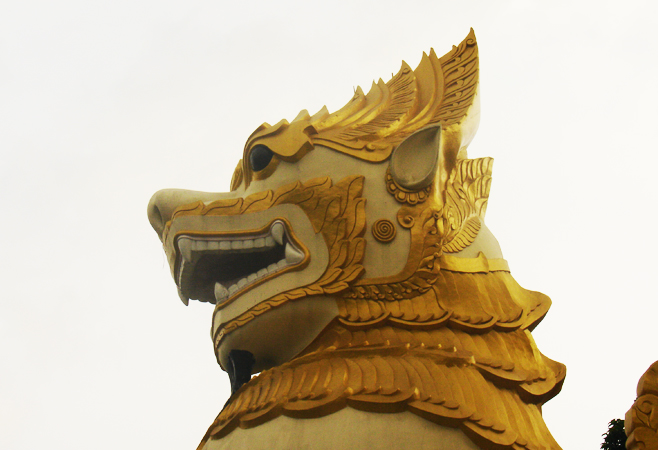
This is a Myanmar grotesque form of a mythical lion. Doe is still look like a lion to you? According to the legendary tales. lions are the best guards for religious shrines. You’ll see statues of lions surrounds many pagodas in Myanmar.
Orge (Belu)
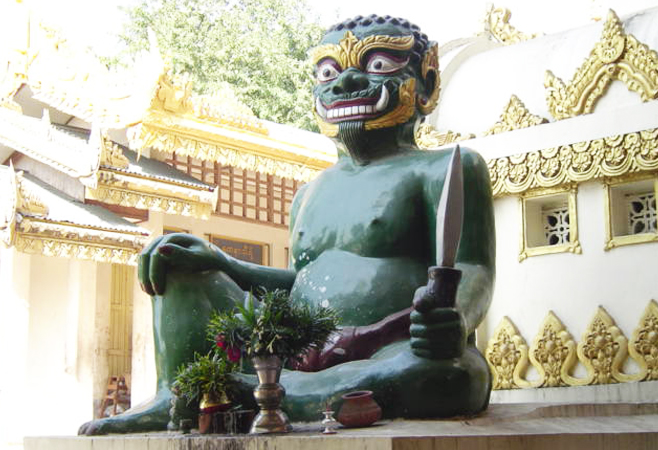
This is just an illustration of the head of an ogre or an oriental gargoyle.
Kanenaree (Kanenayar)

Very gentle mythical bird with human head and torso. Also is a symbol of true love. Kanenaree is a male. Kanenayar is a female. Kayar people believe that they decended from kaneree and kaneyars.
Pyinsa Rupa

It is a combination of 5 animals: elephant. bullock. horse. carp. and toenayar. Alternately lion. elephant. buffalo. carp. and hinthar.
Garuda Bird (Galone)

Mythical king of birds. It has a peak. 2 wings. 2 hands. and 2 legs.
Magan

Mythical sea monster resembling a crocodile with a prehensile snout.
Manote Thiha

Fabulous mythical creature with a man’s torso and a lion’s hindquarters. depicted in a squatting sposture on forked haunches. So it has 6 legs. I wonder how it runs!
Nagar (Dragon)

Mythical dragon or serpent without legs. which breath fire. and can turn things to ash just by a look.
Hinthar

Brahminy duck
Sar Mayee

A large long-haired wild or domesticated ox
Toenayar or Nayar

Mythical dragon or serpent with 4 legs.
Karaweik
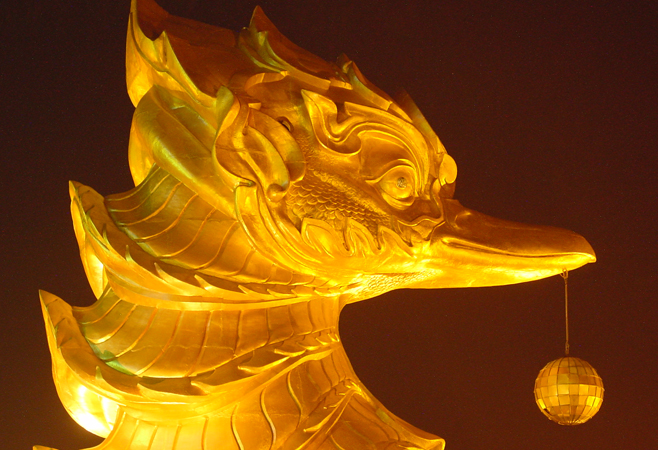
Mythical bird supposed to have a pleasant melodious cry. Considered as a sacred commuter bird.
Folk Elements in Burmese Buddhism
Myths and Spirits in Modern Myanmar
Mythical creatures in Burmese folklore
BEASTS
Birds
- Galone – garuda the archbird, nemesis of the serpents Nāgas.
- Hintha – Hamsa the Brahminy bird, famed as the bird with most pleasant voice; symbol of the Mon people, Mon State and Bago Region.
- Karaweik – from the Pali “karavika”, a bird with a melodious cry.
Reptiles
- Magan – Makara ,crocodile-like sea monster with prehensile snout.
- Nāga – dragon-like serpents with great powers, enemies of the Garudas, and inhabit in the sea. They are described as being able to swim through the earth as if it was water, and fly in the sky. According to the Bhuridatta Jataka the 6th of the 10 last lives of the Buddha, the Buddha was a Nāga prince.
- Ngamoeyeik – a super giant crocodile and character of Min Nandar and Shin Hmwe Loon the Burmese equivalent of Romeo and Juliet.
Mammals
- Kyut – malevolent pangolin or armadillo like creatures which can assume human form and trick humans in the barren forests.
- Sarmaree – vain long-haired yak
which values its hair.
- Thaman Kyah – the weretiger, a somewhat equivalent of werewolf in European cultures.
Spiders
- Giant Spider of Pindaya – a giant spider which held 7 princesses captive in Pindaya region.
Hybrids
- Byala – Rakhine version of the Nawa Rupa. A creature with nine hybrid features.
- Kinnara, male and Kinnari, female – a hybrid of human and bird, often painted as humans with wings in clothing and headdresses; associated with the Shan and Kayah States.
- Manotethiha (Manussiha in Pali) – Sphinx-like Half-human, half-lion creatures. Their appearances are somehow similar with sphinx. What differ them from sphinx is that they have two lion bodies connected to a single human head.
- Nawarupa – (lit nine features); a creature made from the amalgamation of parts of nine different animals.
- Nāya/ Toe-nāya/ Toe-nāga – quite similar to chimera; hybrids of seven animals including Nāga. No appearance of these creatures is found in mythology. They are artistic designs of a nāga developed by early Myanmar sculptor.
- Pyinsarupa – (lit five features); a creature made from the amalgamation of parts of five different animals, mascot of Myanmar Airways International
NAWARUPA

Literally meaning having ‘nine forms’, Nawarupa, also known as byala (especially Arakenese myths), is a hybrid mythical creature that is said to have an assorted composition from nine different animals. Often used in motifs that bedecked the royal barges, the creature is described as having the conspicuous trunk of an elephant, the horns of a rhino, the eyes of a deer, the ears of a horse, the wings (or possibly tongue) of a parrot, the body of a lion, the tail of a peacock (or yak), and feet of Chinthe (the griffin like creatures often depicted in Buddhist pagoda complexes). A similar mythical critter known as the Pyinsarupa (‘five forms’) is used as a heraldic device of Myanmar’s current flagship air carrier.


Comments
Post a Comment