MYTHOLOGIES OF BOLIVIA

Bolivian myths and legends are as colorful and extraordinary as the 36 Cultures of Bolivia. Each Bolivian culture has its own mythology and legends, many of which tell of a people’s origins, beliefs or history. One of the most interesting things is to hear these legends told in a native language like Aymara or Guaraní as storytelling is often accompanied by native rituals. Because there are so many cultures in Bolivia, there are literally hundreds of Bolivian legends. You’ll see some below. You can find more Bolivian myths, or share Bolivian myths and legends you know.
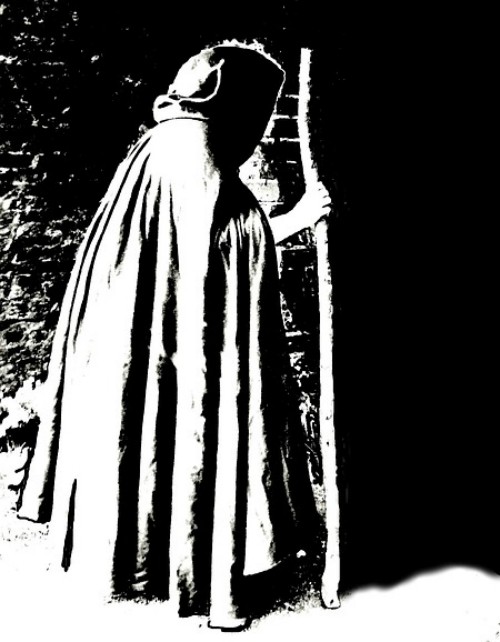
The Legend of the Headless Priest
This legend is common in most of South America, therefore many versions exist. It tells of a ghost dressed as a priest, who went around town after midnight to scare the few persons who dared go out late in the night. His particularity was that he had no head, though in some versions he had one but it was a fleshless skull. It is said that in reality it was a bon-vivant priest who loved to play pranks on his naïve flock; to be able to visit his mistresses without being recognized, he dressed himself in such a way his head was completely covered and it looked as if he had no head at all. This way, he could go see his ladies as much as he wished and nobody suspected it was him, scared to death as they were by the headless padre.

SPIRITUALITY, LAKE TITIKAKA AND ANCIENT TIWANAKU
The Tiwanaku Empire connected spirituality, power and authority between the physical space of Lake Titikaka and the highland site of Tiwanaku. Temples were built at both sites and the shared imagery of the snake, condor and puma are significant in the religious and cosmological expressions that linked the two sites. Several scholars have pointed to the connection between the spirituality, agricultural patterns, monumental architecture and artistic depictions of the Tiwanaku to earlier and other regional cultures, such as Chiripa, Pucara and Cusco. Known as the Yaya-Mama Religious Tradition, many artifacts discovered in the Lake Titikaka region feature similar motifs and show a long integration within the geography and cultures of the region. Lake Titikaka was the spiritual birthplace and center of the cosmos in the Tiwanaku and Incan worldviews and remains a sacred site for the indigenous peoples who continue to live in the region. Lake Titikaka is named for the puma, a spiritually powerful animal. In the modern-day Quechua language, titi means puma and kaka means mount, while in Aymara titi means puma and k’ak’a means white- or grey-haired.
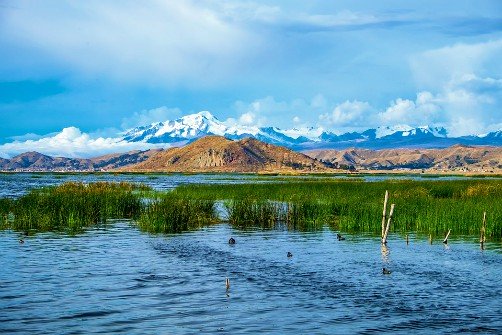
The Legend of Lake Titicaca – How Inti, the Sun god, created Lake Titicaca
The Apus or gods of the mountains had put people in a fertile valley, where they prospered under their protection. Life was good and people were happy, things would stay that way forever as long as they obeyed the Apus’ only prohibition: that they never escalate the mountain where a sacred fire burned perpetually. People obeyed, but the Devil was unhappy of seeing them do so, and persuaded them to compete among themselves to see who was courageous enough to defy the gods and escalate the forbidden mountain, and they all agreed to go fetch the sacred fire. Unfortunately, the Apus caught them midway, exterminated them, and sent pumas to eat those staying in the valley.
Legend of the Ekeko, god of Abundance
In 1781, the indigenous peoples commanded by Tupac Katari rebelled against Spanish rule and put siege to the city of La Paz, where Paulita Tintaya, of Aymara blood, was handmaid to the wife of the governor and army commander of La Paz, Doña Josefa de Rojas. The girl was in love with another servant, Isidro Choquehuanca, also an Aymara, who had to stay at the master’s farm. Isidro had given Paulita an amulet consisting of a clay figure in the shape of Don Sebastian de Rojas, their master and father of Doña Josefa, who was a very short, fat, jovial and red-faced Spaniard.
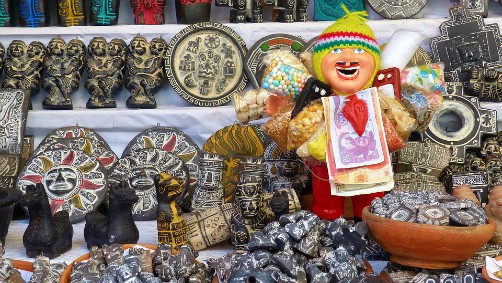
After months of siege, people of La Paz were in a desperate situation, as food and water were scarce. They had to eat even cats and dogs so as not to die of starvation. Only in Paulita’s kitchen food was never lacking, thanks to the clay figure she had put in a little altar, which had miraculously provided the housemaid of enough dried meat, corn and biscuits. In reality, it was Isidro who had given her these provisions, as he was in the indigenous army and therefore able to secretly enter the city.
The Legend of the Ekeko – The Story of the god of abundance and Paulita, an Aymara servant
The Andean Creation Myth – How the god Viracocha created the Earth
In the beginning, the god Viracocha created a lightless Earth, inhabited by giants that neither respected nor obeyed him. Enraged by their behavior, he sent a huge flood that exterminated all life on the planet. Then, he decided to create new people, in a shape and size similar to his own, and to instruct them, he sent a delegate called Viracochán. This was a wise man that taught humans all techniques and skills and healing methods necessary for life, founded the city of Cuzco (Peru), created a person from whom the Quechua peoples descended, and prophesied the coming of a great empire ruled by them. Not all humans respected Viracochán. Some made fun of him and were turned into stone. Once he fulfilled his mission in Earth, the divine envoy walked into the waters and disappeared.
The silbaco is a bird with a strange call and whose appearance is said to be so shocking that those unfortunate enough to see it can lose their hearing or suffer heart attacks. Initially it sounds like it’s whistling, but as it comes closer, it turns into a heart-stopping screech. The tale claims there was once a man, a very hard-working one, who had a wife and two children. He earned a living by selling wood, and was prosperous, but one day he began to feel ill and began to suffer small transformations until he finally turned into a very strange creature, half man, half bird.
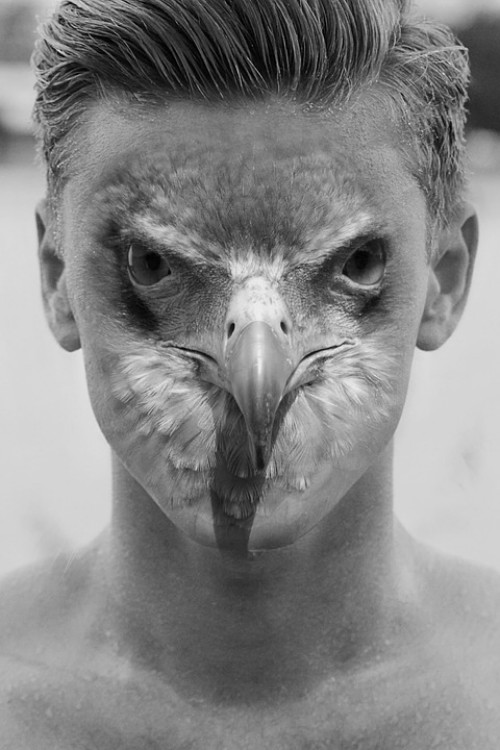
The Legend of the Silbaco Bird – Why this half man, half bird has a horrible screech
Scared, his wife asked for the local priest for help. The priest did all he could, but nothing could stop Pedro’s metamorphosis: he became a bird, an ugly one, all black, and with a high-pitched call, which villagers named Silbaco, as Pedro had been known for his penchant for whistling. The unfortunate man, now a bird, fled to the forest, never to be seen again. On dark nights, his call could be heard, but he was rarely ever seen.
Bolivian Legends: Andean Region
The Legend of Manco Capac and Mama Ocllo – How Inti, the Sun god, created the first humans
The Legend of Desaguadero River – A tale about the river that connects Lake Titicaca to Lake Poopo
The Legend of Illimani and Illampu – A tale of two brother moutains, 2 of the 4 highest in the Andes
The Legend of the Potato – How the father of the gods, Pachacamac, gave us the potato 10,000 years ago
The Legend of Tunupa and Colchani – How the volcano Tunupa became separated from her child, Colchani
The Legend of the Kantuta – The kantuta is one of Bolivia’s two national flowers
The Legend of the Virgin of Urkupiña – The Virgin Mary appeared to a little girl and now half a million people go to see her each year
BOLIVIAN LEGENDS: EASTERN BOLIVIA
The Legend of La Viudita – The story of a horrendous black widow
The Legend of El Carretón de la Otra Vida – A scary carriage from the afterlife
The Legend of the Guajojo Bird – Why was this girl turned into a bird?
The Legend of Bolivianite – The tale of Princess Anahi and the ametrine stone
The Legend of the Toborochi Tree – The story of Araverá and her husband, the Hummingbird
The Legend of El Mojon con Cara – A sweet love story that is said to be true
The Legend of Siete Calles – Why a real group of 7 streets in Santa Cruz is actually 6 now
The Legend of Isireri Lagoon – The tale of this lagoon in San Ignacio de Moxos
The Legend of the Bibosi and the Motacú – A love story of why these two trees grow intertwined
BOLIVIAN LEGENDS: SOUTHERN BOLIVIA
The Legend of the Mule Woman – Why was this woman turned into a mule?
The Legend of Imaybé and Iniguazu – How the gods saved this Chiriguano couple’s child
The Legend of the Headless Priest – Was he really headless and why?
The Legend of the Little Man and the Ghost – A ghost tries to help a friend but it doesn’t go well

EL TÍO
In Potosí, Bolivia, El Tío (The Uncle) is a god/demon worshipped by miners in the Cerro Rico mountain. The miners offer sacrifices in exchange for not being killed by him. He rules over the mountain, and the many deaths that take place within it are said to be caused by his hunger. The Tío may take several different forms, but he most often appears inside the mines as a clay figure resembling the Christian Devil. Typically, an image of the Tío is to be found seated in each active mineshaft in a niche near the miners’ work area. The figures vary widely in their size, composition and design. Some are elaborately sculpted and decorated and may be as large as a human. Most images are smaller and less gaudy, but still easily identifiable due to the horns that grow from the Tío’s head. The icon’s eyes may be made of discarded light bulbs from the miners’ helmets or pieces of metal ore and his teeth are often formed of shards of glass or crystal. At the center of an icon is a lump of metal corresponding to that sought by the miners.
The knowledge that everything is alive. Has consciousness, emotions, intelligence and moods. Everything is alive. Not just animals and plants, but rocks, earth, water, sun, moon, wind and stars as well. That all of these beings are vividly, vitally interconnected, such that individuals are no more than nodes or clusters, a density, of filaments in a great web of fine filaments. That the web is held together, operates, through reciprocal relationships between the nodes or clusters on a basis of the complementarity of opposites. The peoples of what is now Bolivia arrived as gatherer-hunters, and were so for the next 8 or so thousand years. Indeed, in the eastern part, in the rainforests at the headwaters of the Amazon basin, there are people who still live largely in this way. In other words, the peoples of what is now Bolivia remained gatherer-hunters for several thousand years longer than the populations of the Middle East, Europe and China, the ancestors of most of us.
The Abchanchu is a vampire from Bolivia and hunts its human prey by appearing to them as a kindly old man who is lost and in need of assistance. Anyone who helps this creature will soon meet with a tragic end. If the victim does not contract a fatal disease soon after the ill-fated meeting, his body will be discovered drained of its blood. The Abchanchu roams Bolivian roads in the guise of a doddering, frail old man. He appears confused and disoriented, like someone’s helpless old grandpa, and so inevitably a Good Samaritan volunteers to help him. That’s the Abchanchu’s ploy. As soon as opportunity allows, out pop the fangs; his fragility is revealed to be an illusion as the Abchanchu attacks. Under the influence of Dracula-inspired movies, travellers are advised to dab garlic oil on amulets to keep the Abchanchu away. True essential oil of garlic smells so strong that it will likely keep anything away: the power of amulets, sacred texts, and dried garlic flowers carried in a charm bag may be sufficient and definitely more pleasant.

http://www.indigenouspeople.net/SlideshowBolivia/
INDIGENOUS PEOPLES IN BOLIVIA
Quechua (30%), Aymara (25%), Guarani (1.5%), Chiquitano (2.2%), Mojeno (0.85%), Other indigenous (1.5%). 36 groups in all.
Languages
As well as Spanish, Bolivia’s official languages are: Aymara, Araona, Baure, Bésiro, Canichana, Cavineño, Cayubaba, Chácobo, Chimán, Ese Ejja, Guaraní, Guarasuawe, Guarayu, Itonama, Leco, Machajuyai-Kallawaya, Machineri, Maropa, Mojeño-trinitario, Mojeño-Ignaciano, Moré, Mosetén, Movima, Pacawara, Puquina, Quechua, Sirionó, Tacana, Tapiete, Toromona, Uruchipaya, Weenhayek, Yaminawa, Yuki, Yuracaré and Zamuco.
Bolivia has the largest proportion of indigenous people in Latin America, with 62% of the total population of Bolivia considering themselves to be of indigenous descent. This compares with about 50% in Guatemala, 40% in Peru and 35% in Ecuador. The indigenous Quechua and Aymara groups make up the great majority of the population in the northern parts of the Altiplano, and in the higher valleys and basins of the Andes. The Chiquitanos and Guarani-speaking peoples of the eastern lowlands are the third and fourth most numerous ethnic groups. There is a wide variety of small lowland indigenous groupings in the departments of Santa Cruz, the Beni and Pando.
Many of the indigenous languages and ways of life have been maintained as indigenous people represent such a large proportion of Bolivia’s population. Indigenous practices and customs are also reflected in Bolivian popular culture. Although Spanish tends to predominate in urban areas, more than half of the population has an indigenous language as their mother tongue. Community festivals, which continue to play a significant role in rural cultural life, are also still important in those cities with large indigenous populations.
Historically, at the end of the Spanish colonial period, Bolivia’s principal ethnic groups were a majority of Quechua or Aymara indigenous people, a small number of European-descended whites and a larger and more diverse group of mestizos. Political and economic power was largely monopolised by the latter two groups. The term ‘cholo’, which is still in use, was generally adopted to describe an indigenous person considered to be attempting upward mobility through assimilation: taking on the norms and cultural and linguistic identity of a mestizo.

INDIGENOUS PEOPLES IN BOLIVIA
There are 36 recognized peoples in Bolivia. With the adoption of the UN Declaration on the Rights of the Indigenous Peoples and a new Constitution, Bolivia adopted the status of a plurinational state. However, the country’s Indigenous Peoples still face challenges, especially in terms of seismic work in search of new oil and gas reserves and hydroelectric projects.
The UN Declaration on the Rights of the Indigenous Peoples was approved by Law in November 2007. Since 1991, Bolivia is a signatory of ILO Convention 169, an international legal instrument dealing specifically with the rights of indigenous and tribal peoples.
THE QUECHUA, AYMARA AND OTHER INDIGENOUS GROUPS
According to the 2012 National Census, 41% of the Bolivian population over the age of 15 are of Indigenous origin, although the National Institute of Statistics’ (INE) 2017 projections indicate that this percentage is likely to have increased to 48%.
There are 38 recognised peoples in Bolivia, the majority in the Andes are Quechua-speaking peoples (49.5%) and Aymara (40.6%), who self-identify as 16 nations. In the lowlands, the Chiquitano (3.6%), Guaraní (2.5%) and Moxeño (1.4%) peoples are in the majority and, together with the remaining 2.4%, make up 20 recognised Indigenous Peoples.
According to the 2012 National Census, 41% of Bolivians over the age of 15 are of Indigenous origin although the 2017 projections from the National Statistics Institute (INE) indicate that this may now have increased to 48%. Of the 36 peoples recognised in the country, most Quechua (49.5%) and Aymara (40.6%) speakers live in the Andean region where they self-identify as one of 16 nationalities. The Chiquitano (3.6%), Guaraní (2.5%) and Moxeño (14%) peoples live in the Lowlands where, together with the remaining 2.4%, they make up the other 20 recognised Indigenous Peoples. The Indigenous Peoples have thus far consolidated 23 million hectares of collectively owned land as Native Community Lands (Tierras Comunitarias de Origen/TCO), representing 21% of the country’s total area. Following the approval of Decree No. 727/10, the TCOs changed their official name to Peasant Native Indigenous Territories (Territorio Indígena Originario Campesino/TIOC). Bolivia has ratified the main international human rights conventions and has been a signatory to ILO Convention 169 since 1991, with the UN Declaration on the Rights of Indigenous Peoples in full effect since the approval of Law No. 3760 of 7 November 2007. With the new 2009 Political State Constitution, Bolivia adopted the status of Plurinational State.
ANGST IN THE ANDES
In 12 years as president of South America’s poorest country, Evo Morales has accomplished many of the goals he set forth when he became the first indigenous person to lead Bolivia.
The 58-year-old leftist and former coca farmer has presided over an economy that has grown by an annual average of 4.6 percent since he took office, more than twice the rate for all of Latin America.
After nationalizing the country’s bounteous natural gas reserves, he pursued market-friendly economic policies and invested export revenue in social programs that helped lift more than two million people, nearly a fifth of the population, from poverty.
With a new constitution in 2009, he even changed the name of the country from the Republic of Bolivia to the Plurinational State of Bolivia, reflecting diverse ethnicities that for centuries had felt like second-class citizens.
For Bolivia’s more than 4 million indigenous people, support for Morales appeared to pay off. The poverty rate dropped from 59.9 percent in 2006 to 36.4 percent last year. Access for indigenous communities to electricity, sewerage and water service all grew, according to the World Bank.
Bolivia is a country of great social and economic disparity, as well as discrimination against its indigenous peoples, who constitute the majority of the population. Around the turn of the century, social movements in Bolivia, particularly those involving indigenous people and farmers, experienced expansive growth. The front-line issues that led to this mobilisation were the struggle for self-determination, especially in relation to the exploitation of multinational companies, and the fight against historical inequality, discrimination and injustice. The mobilisation resulted in demands for greater democracy, national control of natural resources, land rights and a movement away from neo-liberalism towards a new, more inclusive, stronger state.
Bolivia is home to 36 Indigenous nations, each with their own language, and has the largest Indigenous population in Latin America at 62.2 percent. Three of Bolivia’s Indigenous languages are endangered but are a part of a rescue program to prevent their extenction. Quechua, Aymara, and Guarani are the country’s most widely-spoken Indigenous languages.

UN, Unions Laud Bolivia’s Work to Value Indigenous Languages
“When an indigenous language dies, unfortunately the knowledge, culture, forms of organization, … knowledge about seeds that are fundamental for Indigenous peoples also dies.”
Since Francisco Pizarro’s conquistadors first clanked into their domain almost 500 years ago, Bolivia’s indigenous people have been subjugated and marginalised by European overlords and their descendants.
But after a bruising struggle between supporters and opponents of President Evo Morales, the country is now poised to adopt a new constitution which could prove a watershed for South America. A referendum on Sunday is expected to endorse a charter which supporters say will empower the indigenous majority and roll back half a millennium of colonialism, discrimination and humiliation.
Indigenous people, who make up more than 60 percent of the population in Bolivia, South America’s poorest country, are taking their first steps towards self-government under their own cultural traditions that date back to pre-colonial times.
Alongside the Dec. 6 presidential and legislative elections, 12 of Bolivia’s 327 municipalities voted in favour of indigenous self-government, which will give them control over the natural resources on their land and a greater say in how to use funds transferred from the central state, as well as redefining how government funds are disbursed.
5 Popular Festivals/Dances in Bolivia
The origin of this folkloric dance is highly debated. There are three commonly accepted theories, while a fourth might be that the Morenada Dance is a combination of the first three:
1. The Morenada originated with the African slaves brought to Bolivia to work in the silver mines of Potosí – hence the dark masks with large tongues, which might represent the exhausted mineworkers.
2. The Yungas theory implies that African slaves worked in the Yungas region of La Paz, in the vineyards – hence the barrel-type costume of male dancers. This is the most unlikely theory since the Yungas region never had a wine production; however, Afro-Bolivians did work in other wine-producing regions such as Chuquisaca.
3. The origin of the Morenada stems from Lake Titicaca, based on 200/300-year-old cave paintings found there, depicting these dances.
11 Things Bolivia is Famous For
A multitude of mountains
Dizzying heights
Lots of llamas
Political unrest
A plethora of protests
Hardline socialism
Bowler hats and frilly dresses
Traffic commanding African mammals
One very crazy prison


Comments
Post a Comment