MYTHOLOGIES OF THE SHAWNEE TRIBE

http://www.indigenouspeople.net/shawnee.htm
SHAWNEE LITERATURE

Tecumseh (/tɛˈkʌmsə/; March 1768 – October 5, 1813) was a Native American leader of the Shawnee and a large tribal confederacy (known as Tecumseh’s Confederacy) which opposed the United States during Tecumseh’s War and the War of 1812. Tecumseh has become an iconic folk hero in American, Aboriginal and Canadian history.
Tecumseh grew up in the Ohio Country during the American Revolutionary War and the Northwest Indian War, where he was constantly exposed to warfare. With Americans continuing to encroach on Indian territory after the British ceded the Ohio Valley to the new United States in 1783, the Shawnee moved farther northwest. In 1808, they settled Prophetstown in present-day Indiana. With a vision of establishing an independent Native American nation east of the Mississippi under British protection, Tecumseh worked to recruit additional tribes to the confederacy from the southern United States. During the War of 1812, Tecumseh’s confederacy allied with the British in The Canadas (the collective name for the colonies of Upper Canada and Lower Canada), and helped in the capture of Fort Detroit. American forces killed Tecumseh in the Battle of the Thames, in October 1813. With his death, his confederation disintegrated. Some tribes simply stopped fighting. Accordingly, the British deserted their Indian allies at the peace conference that ended the War of 1812. As a result, the dream of an independent Indian state in the Midwest vanished, and American settlers took possession of all the territory south of the Great Lakes, driving the Indians west or into reservations.
“In defiance of the white warriors of Ohio and Kentucky, I have traveled through their settlements, once our favorite hunting grounds. No war-whoop was sounded, but there is blood on our knives. The Pale-faces felt the blow, but knew not whence it came. Accursed be the race that has seized on our country and made women of our warriors. Our fathers, from their tombs, reproach us as slaves and cowards. I hear them now in the wailing winds. The Muscogee was once a mighty people. The Georgians trembled at your war-whoop, and the maidens of my tribe, on the distant lakes, sung the prowess of your warriors and sighed for their embraces. Now your very blood is white; your tomahawks have no edge; your bows and arrows were buried with your fathers. Oh! Muscogees, brethren of my mother, brush from your eyelids the sleep of slavery; once more strike for vengeance; once more for your country. The spirits of the mighty dead complain. Their tears drop from the weeping skies. Let the white race perish. They seize your land; they corrupt your women; they trample on the ashes of your dead! Back, whence they came, upon a trail of blood, they must be driven. Back! back, ay, into the great water whose accursed waves brought them to our shores! Burn their dwellings! Destroy their stock! Slay their wives and children! The Red Man owns the country, and the Pale-faces must never enjoy it. War now! War forever! War upon the living! War upon the dead! Dig their very corpses from the grave. Our country must give no rest to a white man’s bones. This is the will of the Great Spirit, revealed to my brother, his familiar, the Prophet of the Lakes. He sends me to you. All the tribes of the north are dancing the war-dance. Two mighty warriors across the seas will send us arms. Tecumseh will soon return to his country. My prophets shall tarry with you. They will stand between you and the bullets of your enemies. When the white men approach you the yawning earth shall swallow them up. Soon shall you see my arm of fire stretched athwart the sky. I will stamp my foot at Tippecanoe, and the very earth shall shake.”
—Tecumseh’s Speech at Tuckaubatchee, 1811

Tecumseh (in Shawnee, Tekoomsē, meaning “Shooting Star” or “Panther Across The Sky”, also known as Tecumtha or Tekamthi) was born about March 1768. His birthplace, according to popular tradition, was Old Chillicothe[7] (the present-day Oldtown area of Xenia Township, Greene County, Ohio, about 12 miles (19 km) east of Dayton). As Old Chillicothe was not settled by the Shawnee until 1774, it is believed that Tecumseh may have been born in a different “Chillicothe” (in Shawnee, Chalahgawtha), which was the tribe’s name for its principal village, wherever it was located. Tecumseh is believed to have been born in Chillicothe along the Scioto River, near the present-day city of Chillicothe, Ohio, or, maybe, in another village the Kispoko had erected not far away, along a small tributary stream of the Scioto, where his family moved just before or not long after his birth.
When Tecumseh was a boy, his father Puckshinwa was “brutally murdered” by white frontiersmen who had crossed onto Indian land in violation of a recent treaty, at the Battle of Point Pleasant during Lord Dunmore’s War in 1774. Tecumseh resolved to become a warrior like his father and to be “a fire spreading over the hill and valley, consuming the race of dark souls.”
At age 15, after the American Revolutionary War, Tecumseh joined a band of Shawnee who were determined to stop the white invasion of their lands by attacking settlers’ flatboats traveling down the Ohio River from Pennsylvania. In time, Tecumseh became the leader of his own band of warriors. For a while, these Indian raids were so effective that river traffic virtually ceased.
“No tribe has the right to sell, even to each other, much less to strangers…. Sell a country! Why not sell the air, the great sea, as well as the earth? Didn’t the Great Spirit make them all for the use of his children?
The way, the only way to stop this evil is for the red man to unite in claiming a common and equal right in the land, as it was first, and should be now, for it was never divided.”
We gave them forest-clad mountains and valleys full of game, and in return what did they give our warriors and our women? Rum, trinkets, and a grave.
Brothers — My people wish for peace; the red men all wish for peace;but where the white people are, there is no peace for them, except it be on the bosom of our mother. Where today are the Pequot?
Where today are the Narrangansett, the Mohican, the Pakanoket,
and many other once powerful tribes of our people?
| Curse of Tippecanoe The name Curse of Tippecanoe (also known as Tecumseh’s Curse, the Presidential Curse, Zero-Year Curse, the Twenty-Year Curse, or the Twenty-Year Presidential Jinx) is used to describe the regular death in office of Presidents of the United States elected or re-elected in years divisible by twenty, from William Henry Harrison (elected in 1840) through John F. Kennedy (1960). Ronald Reagan, elected in 1980, was shot and survived; George W. Bush (2000) survived an attempt on his life unharmed. Tecumseh: paragraphs written by students Tecumseh: His Role in the Cause and Conduct of the War of 1812 |


WHEN I SLEEP
When I sleep
I dream of my people;
In battles long ago.
I see their pain,
Their anger,
Their sorrow.
“I CRY IN MY SLEEP”
The Spirit of our people
Who lived long ago,
Still lives.
“BUT ONLY IN OUR DREAMS”
By: H. M. Sisler, Jr., Shawnee
STORIES/DOCUMENTS
Prior to the Green Corn Festival was the Ceremony held when the first green corn shoots appeared. For the Festival, chanting shamans and warriors circled a cooking fire, carrying cornstalks. These first ears were boiled, removed from the pot, and tied to four tepee-like poles above the fire, as a sacred offering to the Great Spirit. The first ashes were buried, then a large new fire was kindled, cooking corn for the entire village to share in the ensuing feast and dance.
No one of the Shawnee people was allowed to eat any corn, even from his own field, until the proper authority was given. When some corn was ready to be eaten, the one who had the authority announced the date for the Corn Feast and Dance.
On this occasion, great numbers of roasting ears were prepared, and all the people ate as freely as they desired. After this feast, everyone could have what he wished from that particular field.
This was probably the most highly esteemed Peace Festival among the Shawnees and other corn-growing tribes. It might properly be called the First Fruits Festival, similar to the First Roots Festival and the First Berries Festival held annually by many tribes.
Another Corn Feast was held in the fall, but not so universally as the one when the first corn was ready to be eaten. The first one of each year was held at planting time. It was a feast to secure the blessing of the Great Spirit, so that they might have a bountiful crop.
All of these were religious festivals, and all were accompanied by chants and dancing.
Constitution of the United Tribe of Shawnee Indians
United Tribe of Shawnee Indians
P.O. Box 505
Shawnee Reserve 206
De Soto, Kansas 66018
913-583-3236
Jimmie D. Oyler, Principal Chief
Absentee-Shawnee Tribe of Indians of Oklahoma
Eastern Shawnee Tribe of Oklahoma
Address for Tribal Offices:
Kenneth Blanchard, Governor
Absentee-Shawnee Exec. Committee
2025 S. Gordon Cooper Drive
Shawnee, OK 74801-9381
405-275-4030
George J. Captain, Chief
Eastern Shawnee Tribe of Oklahoma
P.O. Box 350
Seneca, MO 64865
417-776-2435
Absentee-Shawnee Executive Committee
P.O. Box 1747
Shawnee, OK 74801
405-275-4030
“Trouble no man about his religion,
respect his views and demand he respect ours.”

KEEPING AN INDIAN CULTURE ALIVE
Twenty men and women, some with feathers dangling from coal-black hair, some with moccasins as footwear, step purposefully in a circle around a barren pole they say reaches to the sky.
In pairs, they walk in cadence with the rhythmic beating of a drum, oblivious to the panoramic views the lofty pasture affords them of the surrounding forested mountains — exploding in brilliant hues of red and yellow — and the river valley below.
From distant vantage points in the ridges that fortress the Youghiogheny River, these conspicuous people might lead you to believe you’ve slipped into another century, when the Shawnees roamed these parts, hunting and fishing.
But this is the late 20th century, and, yes, the Shawnees are again here, atop a mountain overlooking Friendsville, celebrating the Fall Bread Dance, a post-harvest observance that is the last of the traditional summer ceremonies.
These forgotten nomadic Indians — identified more with Oklahoma than the Western Maryland mountains — occasionally surface, as they did last week when a Virginia businessman announced plans to interest the Shawnee in a proposed gambling casino and hotel atop a mountain overlooking Cumberland in neighboring Allegany County.
The Shawnees were among the many bands — no one apparently knows for sure how many — of Indians who lived in and roamed what is now Maryland. Among the better-known were the Nanticoke of the Eastern Shore and the Piscataway of the Western Shore of the Chesapeake Bay.
“Maryland was a stopover for a lot of tribes,” says Archie Lynch, a spokesman for the Native American Center in Baltimore.
Heavy colonization forced the Indians to disperse. The Shawnees migrated from the Maryland mountains to the Ohio Valley and, eventually, to Kansas and Oklahoma.
Some Shawnees remained in and around Garrett County, however, because of marriages to colonists, and their families have lived in the hollows and on the mountains ever since.
Just how many Shawnees once roamed these parts or how many descendants remain is speculative, though.
“We don’t know. Nobody knows,” says Chief Joseph Raincrow, head of the Yougiogaheny River Band of Shawnee Indians, which re-established itself in these mountains in the early 1980s.
“We’re not very big in terms of numbers,” he says. “But the potential is big. There are a lot of eligible Shawnee people in the area who are not involved.”
Chief Raincrow was selected by the band as chief. The group –which has about 200 members from across the nation and Canada — was formed as part of a band in Ohio in 1980, but later separated.
The band’s efforts at re-establishing the Shawnees in Maryland has been aided by Jim “Pappy” Ross Sr., who donated four acres of his farm to the Shawnee band a decade ago. Mr. Ross, 76, is a descendant of the Shawnees and of the town’s founding family, the Friends, who came to the Youghiogheny River valley in the early 1700s.

The Shawnees, Mr. Ross says, allowed the Friends to live on the east side of the river and hunt and fish in the valley. The Indians taught the Friends how to survive on the frontier.
“I thought something should be done to show our appreciation,” says Mr. Ross, whose 120-acre farm abuts the Shawnee tract. “This was their territory. I thought it was better to give it to them than let it get in the hands of some developer and ruin it.”
The modern-day Shawnees, led by Chief Raincrow, a retired administrator and American Indian adviser at American University in Washington, return throughout the year in their station wagons and four-wheel-drive vehicles to set up tents and pop-up trailers for spring planting and fall harvest ceremonies, weddings and naming of the children ceremonies.
“We are living as Indians there,” says Chief Raincrow, an Ohio native who moved to Maryland about 35 years ago and now lives in Bethesda. “That’s the idea — living the way our people used to when they lived there a long time ago.”
The site, which is just above Interstate 68, also is the center of government for the band, Chief Raincrow says. An octagonal house has been erected there.
“We have dedicated the land as a sacred ceremonial site,” Chief Raincrow says.
Ceremonies are conducted during the spring, summer and fall. About 60 people — some from as far away as Ohio and New Jersey — turned out one weekend this month for the Fall Bread Dance, which included a hunting foray into the woods, where a deer was taken, cleaned and roasted all day over a fire for a tribal feast.
They come here to celebrate and learn their heritage.
“When I was young, I used to run out in the woods — I would hear someone calling my name,” says Mike Fink, a 19-year-old Mohawk from Germantown. “It was a calling to my heritage. Other Indians will tell you the same thing.”
Mr. Fink has been welcomed into the Youghiogheny camp even though he is a Mohawk, a traditional enemy of the Shawnees. But even non-Indians are often invited and welcomed, and tourists are drawn out of curiosity off the interstate.
Chief Raincrow, a widower who declines to give his age, travels the country and around the world to lecture about Indians, their history, culture and spirituality.
He has degrees in theology, education, history and political science.
“People have all kinds of strange ideas about what Indians are suppose to look like,” Chief Raincrow says. “Americans think that reservations are synonymous with Indians. But that’s not the case. Most Indians never saw a reservation.”
The Shawnees who come here work in professional and blue-collar jobs. The come with their husbands, wives and children. They sometimes wear traditional woodland garb at these gatherings, sometimes jeans and cowboy hats, often decorated with Indian belts, feathers and ribbons.
Herb Clevenger, a 39-year-old owner of a body shop near Friendsville, frequently attends the Shawnee ceremonies. He believes he is a descendant of Shawnee and Delaware Indians.
“What I’m all about is a traditional Eastern woodland Indian,” he says. “People don’t realize the different cultures within Indians. They tend to think only of Western Indians.”
Being here is a matter of maintaining the culture.
“This is how we take care of our people,” says Joe Far Raven, who has come from Cincinnati. “I’ve been Shawnee all my life. There is no way around it. You live your culture, your heritage.”

The Shawnee creation myth is similar to other Algonquin creation myths in maintaining that the people who are now the Shawnees originated from a different world- an island balanced on the back of a giant turtle-and traveled to this one. According to Shawnee myth, when the first people were on the island, they could see nothing but water, which they did not know how to cross. They prayed for aid and were miraculously transported across the water. The Shawnees are the only Algonquin tribe whose creation story includes the passage of their ancestors over the sea, and for many years they held an annual sacrifice in thanks of the safe arrival of their ancestors to this country. The Shawnees were also unique among the Algonquin peoples in believing their creator was a woman, who they called [Inumsi Ilafewanu] “Kokumthena”, which means “Our Grandmother.” Kokumthena” is usually depicted as an anthropomorphic female with gray hair whose size ranges from gigantic to very small. According to Shawnee myth, the idea of creation came from the “Supreme Being”, who is called “Moneto”, but the actual work of creation was performed by Kokumthena the “Great Spirit”, and she is the most important figure in Shawnee religion.

The Supreme Being of all things is Moneto, who rules Yalakuquakumigigi [the universe] and dispenses His blessings and favors to those who earn His good will, just as He brings unspeakable sorrow to those whose conduct merits His displeasure. “Monteo” is not to be mistaken for the “Great Spirit”, the ruler of deities, who is subordinate to Him. The “Great Spirit” lives in a home in the sky and, in addition to Shawnee and other Native American languages, she speaks her own non-Shawnee language that can only be understood by children under age four- who forget it as soon as they begin to learn Shawnee. In addition to creating the world, Kokumthena will end it. Prophets who travel to the after world find her weaving a blanket called a skeemotah, but she has a wolf who unravels what she has done. (I have included this story as told to me by my Grandmother…Woman and the Wolf) Someday, however, she will complete her blanket, scoop up the virtuous to come live with her, and punish and destroy the wicked.

The Shawnee Tribe is an Eastern Woodland tribe. They originally came from Ohio and Pennsylvania, and were the last of the Shawnee to leave their traditional homelands there. In the late 18th century, European-American encroachment crowded Shawnee lands in the East, and one band migrated to Missouri — eventually becoming the Absentee Shawnee. Three reservations were granted to the Shawnee in Ohio by the 1817 Treaty of Fort Meigs: Wapakoneta, Lewistown, and Hog Creek. After the Indian Removal Act of 1830 passed, another Shawnee band relocated to Indian Territory in the July 1831. The final band, who would become the Shawnee Tribe, relocated to Kansas in August 1831. Their Kansas lands were drastically reduced in 1854 and broken up into individual allotments in 1858.

Absentee Shawnee Tribe of Oklahoma
The Absentee are a division of the Shawnee tribe who originally lived in the eastern United States, in Ohio, Indiana, Illinois, Kentucky, Tennessee, Pennsylvania, and other neighboring states. These Algonquian-speaking people travel widely through lands from Canada to Florida and from the Mississippi River to the eastern continental coast. During the American Revolution, many Shawnee moved from the Northwest Territory to Cape Girardeau, Missouri, and later, others moved into Louisiana. These bands were later joined by other Shawnee groups from Alabama and Ohio, and some relocated into Arkansas and Texas.

Painting of Kokumthena, the Shawnee Creation Goddess

The Shawnee are an Algonquian-speaking indigenous people of the Northeastern Woodlands. In the 17th century they lived in Pennsylvania, and in the 18th century they were in Pennsylvania, Ohio, and Indiana with some bands in Kentucky and Alabama.[2] By the 19th century they were forcibly removed to Missouri, Kansas, Texas, and ultimately Indian Territory, which became Oklahoma[2] under the 1830 Indian Removal Act. Today Shawnee people are enrolled in three federally recognized tribes, all headquartered in Oklahoma: the Absentee-Shawnee Tribe of Indians, Eastern Shawnee Tribe of Oklahoma, and Shawnee Tribe.

Most historians classify early Shawnee Tribes as a nomadic people because historians have found creditable evidence of Shawnees moving about in North America, settling in various places, and often retaining small family units for long periods of time. The State of Alabama has long been the home of many Shawnee people. In fact, some historians report that perhaps the Shawnees have inhabited Alabama for a longer period of time than any other geographic region. Some archaeologists set the date of 1685 as the first evidence of Shawnee settlement in Alabama. However, oral tradition recounts that the Shawnee have lived in Alabama much longer that. Ancient burial sites that used burial methods common to the Shawnee have been located in several sections of the State of Alabama. Early accounts can be confusing since what is now called Alabama was once a part of the Georgia Territory. Several early maps show Shawnee settlements in what is now the State of Alabama.


Thunderbird of the Shawnee Peoples
Like many other tribes, the Shawnee people also believed the Thunderbird could change its appearance in order to interact with people. Their beliefs, however, detail that Thunderbirds appeared as boys and could be identified by their tendency to speak backwards. The Thunderbird is considered to be a mighty creature of enormous size. They are often depicted as being a fantastic size that is difficult to comprehend – a single feather from the Thunderbird’s wingspan is said to be so large that it would need to be folded in half to properly fit into a quiver. It is often said that a Thunderbird is able to pick up a whale in its talons. The frequency with which whales are mentioned in these legends may suggest that whales were a favorite food source of hungry Thunderbirds.

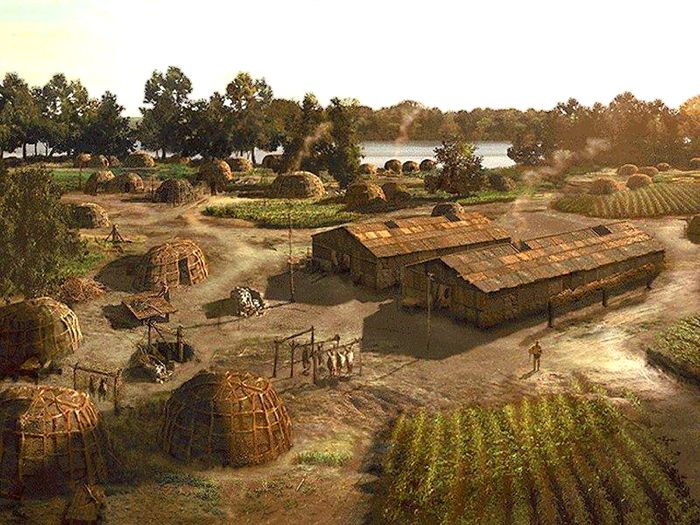
The Shawnee, whose name means “Southerners”, once occupied a vast region west of the Cumberland mountains of the Appalachian chain in what is now part of Tennessee, Kentucky, Ohio, and West Virginia. Like the other Algonquian-speaking tribes of the western part of the Northeast Woodlands Culture Area, the Shawnee had a traditional economy based on farming (corn, beans, and squash), hunting, and gathering wild plants. “In the Shawnee world, humans and animals communicated, hunters dreamed the whereabouts of their prey and offered prayers to the spirits of the animals that gave their bodies so that the people might live.” In order to maintain the harmony between humans and the animal people, and between humans and the plant people, it was necessary to conduct certain rituals to keep the world in balance.

Shawnee reclaim the great Serpent Mound
The Shawnee tribe returned home to the Serpent Mound on the longest day of the year. The Summer Solstice, June 20, the longest day of the year, marks the first time that the Shawnee tribe has officially returned to the Serpent Mound located in Ohio to present their history and connection to this place that they called home so many years ago. Although it was certainly ancestors of the Shawnee people who built the magnificent serpent shaped mound, the largest earthwork effigy in the world, Ohio failed to involve the tribe in conveying its meaning to the public until now. Glenna Wallace, chief of the Eastern Shawnee Tribe of Oklahoma and Ben Barnes, chief of the Shawnee Tribe, also located in Oklahoma, spent the weekend telling visitors to the Serpent Mound historical site about their peoples’ and ancestors’ connection to Ohio and the mound.

The Shawnee Sachemate (also called the Shawnee Kingdom) is an indigenous Kolumbian monarchy located in the Midwestern region of Kolumbia, centered along the Ohio River Valley in an urban center known as the Shawnee Pentapolis. The Shawnee first established a mound-building culture in the Keehita region around 1000 AD, as a branch of the earlier Hopewell Culture. Urbanization and centralization quickly evolved over the next few centuries, resulting in the formation of the Shawnee Confederacy in the late 13th century. After multiple failed attempts by the Iroquois Confederacy to subjugate the region, the Shawnee established a fully-centralized government around the city-state of Chillicothe, ruled by a single hereditary Sachem or “King”.

The Shawnee are an Algonquian-speaking Native American tribe whose original origins are unclear. But, by 1600, they were living in the Ohio River Valley in the present-day states of Ohio, Kentucky, Pennsylvania, West Virginia, and Indiana. At this time, they were estimated to have numbered about 10,000 people. Their name comes from the word “shawun,” meaning “southerner.” The Shawnee are traditionally considered the Lenape (or Delaware) of the East Coast mid-Atlantic region, as their “grandfathers” and the source of all Algonquian tribes. They shared an oral tradition with the Kickapoo that they were once members of the same tribe. The identical language of the two tribes supports this oral history and the fact that they were both living in northeast Ohio before European contact. They also had a special friendship with the Wyandot, who they referred to as their “uncles.” The Shawnee divided themselves into different clans, and their principal leaders could only come from the “Chillicothe” clan. When a village was called Chillicothe, it meant that it was home to the principal chief, the “capital city” of the Shawnee. Their chiefships were hereditary and held for life. The tribe was patrilineal with descent and inheritance traced through the father. War chiefs were selected based on merit and skill.

Escaped Auschwitz, outfoxed Nazis, promoted Indian folklore Young Shawnee brave! Throughout his life, Stanisław Supłatowicz popularized Indian folklore in Poland by writing numerous Indian-themed adventure books. He also demonstrated Indian handicrafts and gave numerous talks on Polish TV shows. Sat-Okh was the founder of the Polish Friends of Indians Movement, and in 2000 set up a North American Indian Museum in the northern Polish town of Wymysłów.

According to prisoners taken by the Shawnee Indians from the white settlements in Kentucky and Ohio, just a half day’s walk from their main village of Chillicothe was a site where the Shawnee mined silver. The prisoners were blindfolded, marched to the site, and burdened with heavy sacks which they were forced to carry back to the village. The difficulty in finding the site has been complicated by the fact that there was more than one village named Chillicothe, and the villages moved from time to time. There were villages of that name – actually Chalagawtha – on the Scioto River, the Little Miami River, the Great Miami River, and others. The prisoners who described carrying the silver mentioned that it came from a place not far from a stream. Chillicothe on the Little Miami is sometimes referred to as Old Chillicothe to distinguish it from the others of that name and is the most prominently discussed region when considering the location of the mines because it was the largest of the villages. Its most prominent leader was Chief Blackfish, and it was to this village that Daniel Boone was taken when he was held prisoner by the Shawnee. Tecumseh is often said to have been born there, in reality, he was born in the village on the Scioto, though he did live on the Little Miami for a time. Today the area is an unincorporated village called Oldtown.

The Shawnee creation myth is similar to other Algonquin creation myths in maintaining that the people who are now the Shawnees originated from a different world- an island balanced on the back of a giant turtle-and traveled to this one. According to Shawnee myth, when the first people were on the island, they could see nothing but water, which they did not know how to cross. They prayed for aid and were miraculously transported across the water. The Shawnees are the only Alonguin tribe whose creation story includes the passage of their ancestors over the sea, and for many years they held an annual sacrifice in thanks of the safe arrival of their ancestors to this country. The Shawnees were also unigue among the Alonquin peoples in believing their creator was a woman, who they called [Inumsi Ilafewanu] “Kokumthena”, which means “Our Grandmother.” Kokumthena” is usually depicted as an anthropomorophic female with gray hair whose size ranges from gigantic to very small. According to Shawnee myth, the idea of creation came from the “Supreme Being”, who is called “Moneto”, but the actual work of creation was performed by Kokumthena the “Great Spirit”, and she is the most important figure in Shawnee religion. The Supreme Being of all things is Moneto, who rules Yalakuquakumigigi [the universe] and dispenses His blessings and favors to those who earn His good will, just as He brings unspeakable sorrow to those whose conduct merits His displeasure. “Monteo” is not to be mistaken for the “Great Spririt”, the ruler of detinies, who is subordinate to Him. The “Great Spirit” lives in a home in the sky and, in addition to Shawnee and other Native American languages, she speaks her own non-shawnee language that can only be understood by children under age four- who forget it as soon as they begin to learn Shawnee.

The Native American peoples of North America do not share a single, unified body of mythology or literature. The many different tribal groups each developed their own stories about the creation of the world, the appearance of the first people, the place of humans in the universe, and the lives and deeds of gods and heroes. Yet, despite the immense variety of Native American mythologies, certain mythic themes, characters, and stories can be found in many of the cultures. Underlying all the myths is the idea that spiritual forces can be sensed throughout the natural world—including clouds, wind, plants, and animals—which they shape and sustain. Many stories explain how the actions of gods, heroes, and ancestors gave the earth its present form. According to the mythologies of most Native American cultures, people originated in the places where their ancestors traditionally lived. Some tales speak of ancient migrations. Native Americans are descended from hunting and gathering peoples of northeastern Asia who migrated across the Bering Sea into North America during the most recent Ice Age. During that Ice Age, which ended around 8000 bce, the level of the oceans was much lower, and a bridge of land linked Siberia and Alaska. Some groups may also have reached Alaska from Siberia by boat or by walking on ice. Over thousands of years, the population of North America grew and diversified into the peoples and cultures that Europeans encountered when they began to colonize the continent in the 1500s ce.


Comments
Post a Comment